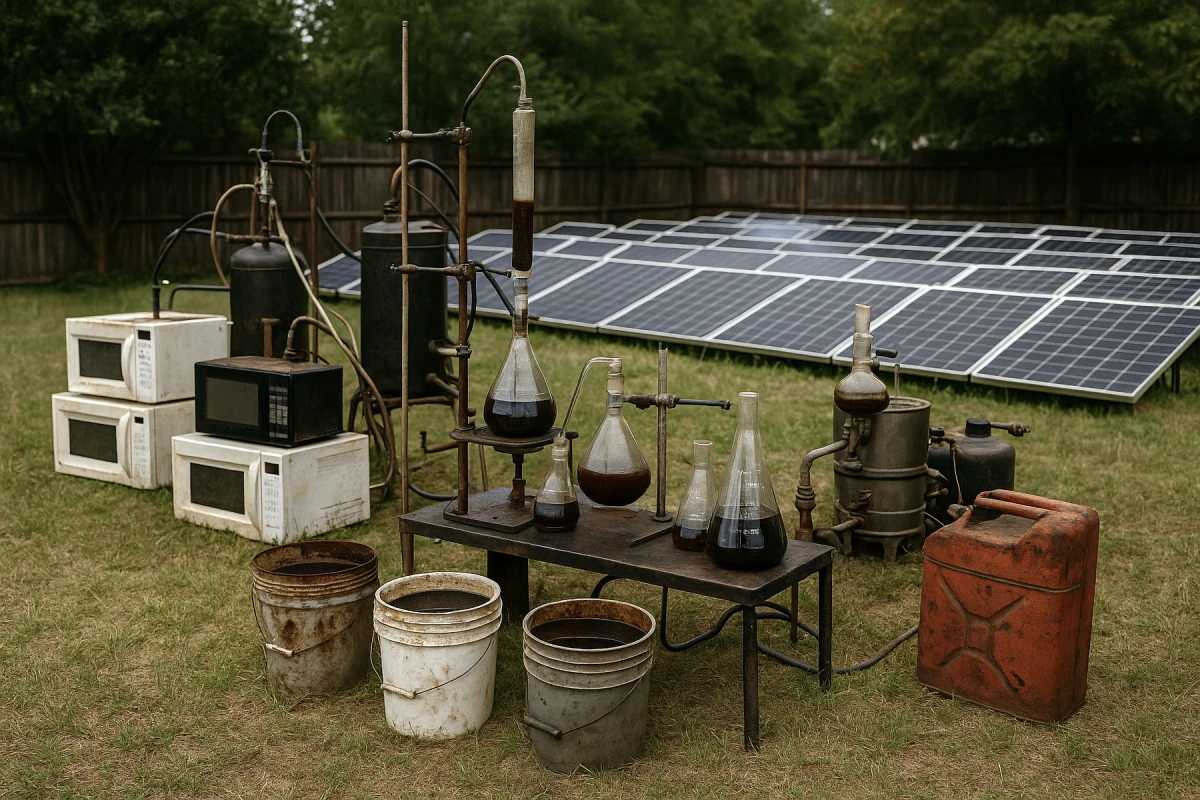
AI generated
Imagine this: 21-year-old backyard inventor Julian Brown, in Alabama, clears away dirt and leaves from his DIY pyrolysis microwave reactor—powered by solar panels, a generator, and ten magnetrons likely pulling over 8 kW. Into the machine, he loads plastic waste like shopping bags, detergent bottles, and milk jugs—trash that would normally end up in a landfill. What comes out first is a thick, sludgy substance resembling blown head gasket oil or lumpy chocolate milk. That’s just the start, though—he then begins a homemade refining process to create what he calls “plastoline,” a gasoline alternative.
Brown’s refining process is essentially basic distillation—though it involves a lot of unnecessary back-and-forth pouring between beakers, all taking place under a carport on a gravel driveway in his backyard.
Online, he goes by the name NatureJab, and his project has been slowly gaining attention through social media and local news coverage. His actual business is called Jab’s Pyrolysis & Energy Recovery.
From Backyard Reactors to Carbon Neutrality: Brown’s Vision, One Video at a Time
On YouTube, Brown has uploaded a trove of videos featuring the various reactors he’s built and tested. After watching several, it’s clear the content is pretty chaotic—filled with rants, dance breaks, and abrupt edits. That said, in one video from three years ago, he lays out his vision: to convert plastic waste into usable fuel through microwave pyrolysis powered by renewable sources like solar and wind, with the ultimate goal of achieving carbon neutrality.
Despite a scattering of solar panels across his yard, a gas-powered generator can be heard humming in nearly every clip—so he’s not exactly carbon-neutral yet. And the toxic fumes? Let’s just say the EPA probably wouldn’t be thrilled.
Brown admits that plastic pyrolysis does produce significant carbon emissions. Still, he argues that traditional plastic recycling—especially the collection, sorting, and transport—generates even more.
“Pyrolysis isn’t rocket science,” said Brown at age 18. “It’s straightforward—fewer steps, less transportation, and lower emissions. Simple.”
As for the toxic gases produced during the process, he added, “Scrubbers and filters can trap any harmful byproducts. Plus, with the right chemical processes and advanced systems, those toxic substances can actually be turned into something useful.”
Brown Sees Renewable-Powered Pyrolysis as the Best Way to Tackle Unrecyclable Plastic Waste
Brown acknowledges the basic law of thermodynamics—that pyrolysis always requires more energy in than it produces. Still, he emphasizes that plastics are highly energy-dense and can yield a variety of valuable byproducts beyond just his fuel blend, “plastoline.” In his view, microwave pyrolysis powered by renewable energy offers the safest and most accessible method for dealing with plastic waste that can’t be recycled and would otherwise pollute landfills or oceans.
From what I’ve gathered across his many videos, Brown is now working on what he calls the “Mark 4.5 reactor,” which will be powered by ten magnetrons salvaged from old microwaves. I say “will,” because as of earlier this month, he was still in the process of fabricating waveguides for the build.
In his earlier setup, he loads a batch of mixed, unwashed plastic waste into the reactor and “zaps” it for four to five hours. The resulting crude is then distilled—using a ShopVac, no less—into a rough fuel mix he calls plastoline, which he claims can function like gasoline, diesel, or even jet fuel.
Brown Demonstrates Plastoline by Powering Vintage Truck at Houston Event
He recently showcased the fuel by running a carbureted vintage truck on plastoline at a small event in Houston, Texas. As shown in the video, the demo wasn’t exactly a controlled lab trial—the fuel was hanging from the front of the truck in a paint bucket.
Brown’s Crowdfunding Efforts Fuel His Backyard Energy Experiments
I found at least two active GoFundMe campaigns run by Brown. One, launched in April 2025, has raised nearly $29,000—far exceeding its $16,000 goal. The funds are earmarked for equipment like a 20-kW solar inverter (to convert DC from solar panels into usable AC), 60 kWh worth of lithium batteries, a charge controller, and various wiring for his solar setup. His earlier and still-active campaign, started in January 2023, aims for a much more ambitious $1 million to support ongoing development of his plastoline fuel. So far, it’s brought in just over $17,000.
In May 2024, Brown experienced a serious accident involving his DIY pyrolysis setup. His distillation unit wasn’t properly sealed under vacuum as intended, and flammable vapors ignited, leading to an explosion. Wearing only a T-shirt, shorts, and no shoes, Brown took the brunt of the blast to his feet and sustained significant second-degree burns.
Despite the setback, he wasn’t deterred. He learned from the failure and pressed on with his work on plastoline.
Independent Testing of Plastoline Reveals High Levels of Toxic BTEX Compounds
Later that year, in December 2024, three samples of plastoline were sent to Ben Katz, a well-known YouTuber and proteomics expert who runs the Mass Spec Everything channel. Katz, also a staff scientist at UC Irvine’s Mass Spectrometry Facility, analyzed the samples in a short video. Rather than focusing on fuel performance, he zeroed in on safety concerns. His GC-MS analysis revealed high concentrations of styrene and other BTEX chemicals—toluene, ethylbenzene, and xylene—all of which are arguably more toxic than ingredients typically found in conventional gasoline.
“What you’re essentially producing here is BTEX gas,” Katz explains. “I’m not trying to discourage your effort, your passion for science, or all the impressive work you’ve been doing. But as an analytical chemist who’s looking directly at the data, I just want to urge caution. Please use proper protective gear and take steps to protect yourself—I’d hate to see you get seriously ill. I’m just genuinely concerned about your safety.”
The Long Road of Plastic Pyrolysis
Plastic pyrolysis has been around since the 1970s, when researchers explored breaking down polymers like polyethylene to recover hydrocarbons. It became commercially viable in the 2000s thanks to better tech and rising concern over plastic waste.
In 2019, Sparta Group and Phoenix Canada began converting five tons of plastic into about 4,000 liters of fuel, powering a fleet of 10 trucks in a closed-loop system. Their facility can process 18,000 tons annually. RES Polyflow operates on a larger scale, handling 100,000 tons of plastic per year and producing up to 18 million gallons of fuel components like diesel and naphtha.
Today, many companies use pyrolysis to make fuels and chemicals from plastic waste.
What makes Julian Brown stand out is that he’s taking on this billion-dollar industry from his backyard—with a welder, a dream, and two scorched feet.
Read the original article on: New Atlas
Read more: A Water-Injected 2.0-Liter Hydrogen Turbo-Four Engine Generates 410 hp.

