

US Department of Energy
Bringing a new dimension to underground energy, Deep Fission Nuclear has raised US$30 million to build a micro-reactor inside a borehole one mile (1.6 km) deep, with completion targeted for July 4, 2026, under the US Department of Energy’s Reactor Pilot Program.
An unconventional approach to reactor design
More than a year ago, the company unveiled its unconventional plan: to drill a 30-inch (76-cm) shaft through solid rock in a geologically stable area and lower a fully assembled reactor to the bottom on a cable.
Though the concept may sound unusual, it addresses several of nuclear energy’s most pressing challenges: high costs, safety concerns, and security risks. Traditional nuclear power plants, particularly in Western countries, often take decades to build and cost tens of billions of dollars. Alongside the expense, fears of catastrophic accidents and potential sabotage have long overshadowed the technology.
Deep Fission aims to tackle these issues by rethinking reactor placement.
Deep Fission
The bulk of nuclear plant costs typically stem not from the reactor itself but from the extensive infrastructure required to contain it. Housing the reactor far below ground could streamline design and reduce above-ground construction expenses by up to 80%.
Design details of the modular reactor
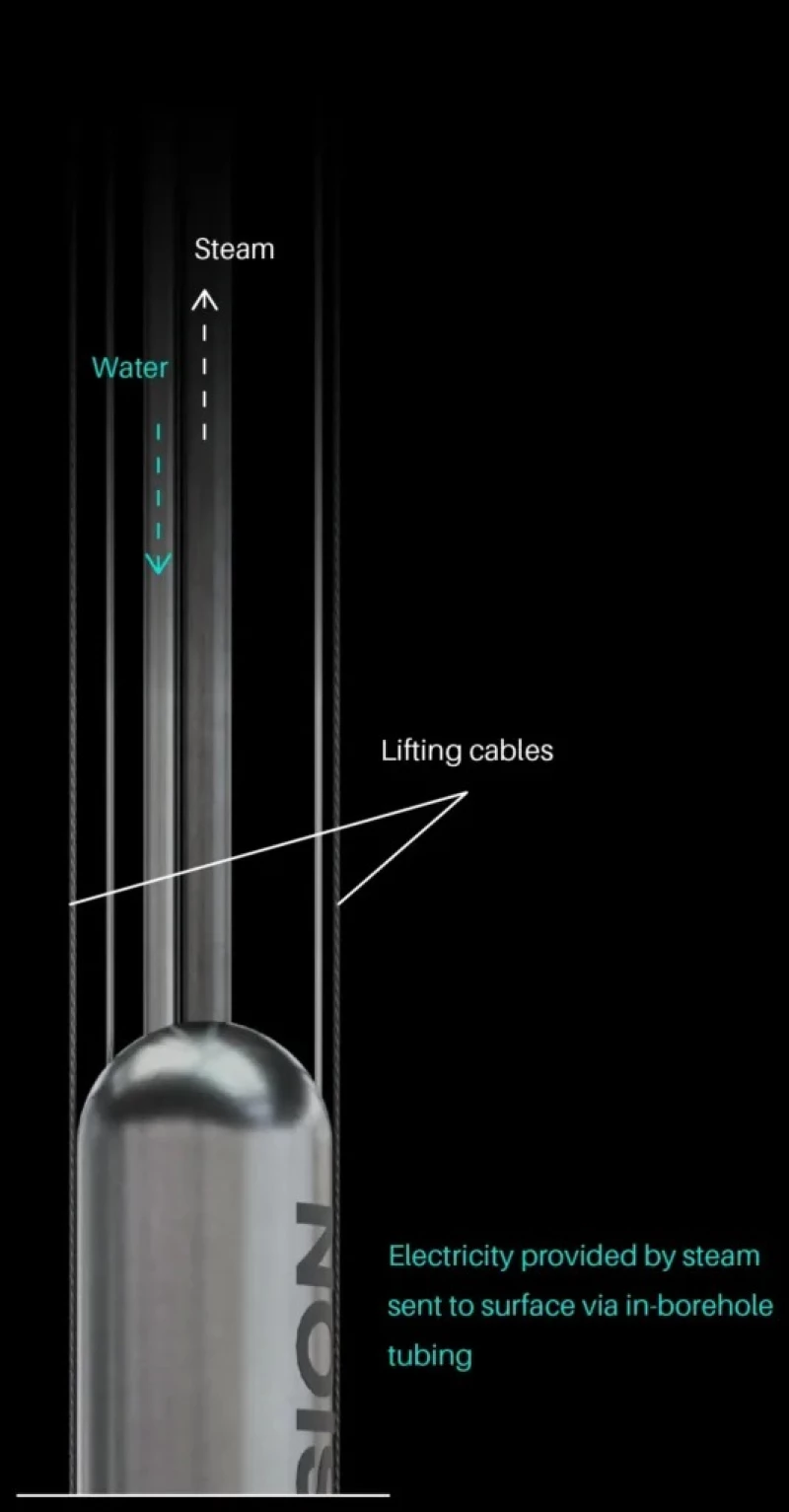
The company’s current design calls for a compact 15-MWe modular reactor, fueled by low-enriched uranium (LEU) and operating at about 315 °C (600 °F). The unit would be lowered into a water-filled borehole, connected by two insulated pipes—one sending water down, the other returning non-radioactive steam to drive turbines at the surface. The water column and surrounding rock would naturally maintain reactor pressure at 160 ATM (2,352 psi), eliminating the need for specialized pressurization equipment.
This underground setup would require only a quarter to half an acre (roughly 1,000 to 2,000 m²) on the surface. By placing the reactor so deep, conventional containment structures become unnecessary, while security is enhanced by the inaccessibility of the site.
Geology as a built-in safety mechanism
The geology itself adds another safety layer. Drilling below the water table in a stable formation means that, in the unlikely event the reactor becomes irretrievable, operators could seal the borehole with rubble and concrete. At that depth, the water table remains protected, and uranium migration through solid rock is negligible, even over millions of years.
Deep Fission estimates a pilot plant could be built in just six months, and if scaled commercially, the technology could deliver electricity at five to seven cents per kWh.
Deep Fission’s vision for nuclear energy
This is a pivotal moment for nuclear power, said Liz Muller, Co-Founder and CEO of Deep Fission. We have the right technology at the right time and place. With this funding, we can move ahead with our pilot reactor and aim to finish by 2026. We’re confident our design can scale quickly and profitably to meet the soaring energy demands of AI data centers and other global customers.
Read the original article on: New Atlas
Read more: Nuclear Waste Could Become a Source of Tritium for Fusion Power


