University of Texas
Similar to a car’s low-fluid warning light, a new wearable sensor connected to a smartphone app is designed to alert users when their hydration levels drop to dangerous levels. This innovation could prove especially useful for athletes, emergency responders, and others with high physical demands.
From Mild Symptoms to Medical Emergencies
Although recommendations on daily water intake vary widely, medical experts agree on the clear signs of dehydration. Early symptoms include intense thirst, dizziness, and fatigue. Without timely rehydration, more severe effects can follow, such as rapid heartbeat, low blood pressure, confusion, delirium, and in extreme cases, shock.
One of the subtler signs of dehydration is a decrease in the body’s ability to conduct electricity. Since water is a good conductor, a drop in tissue water content leads to increased electrical resistance—a phenomenon known as bioimpedance.
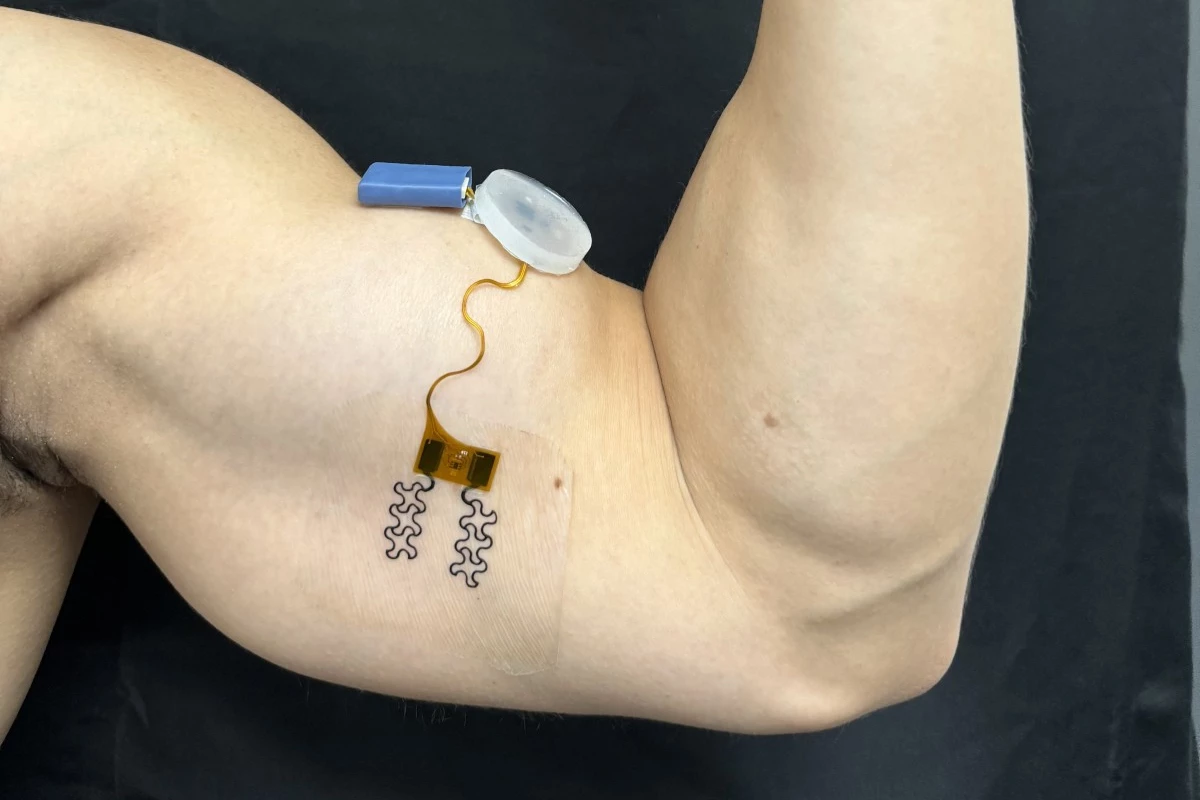
To take advantage of this, researchers at the University of Texas at Austin created a compact, battery-powered sensor that attaches to the bicep. It sends a harmless electrical current through the tissue and measures resistance. This data is then wirelessly transmitted to a smartphone, allowing for continuous, real-time hydration monitoring.
In testing, volunteers were given a diuretic to induce dehydration. Researchers then compared urine samples with readings from the sensor and found a strong correlation between the two.
The Vital Signs of Dehydration
“Our results show that arm bioimpedance responds sensitively to hydration changes and matches well with full-body hydration assessments,” said study co-author Matija Jankovic in a paper published in PNAS. “This confirms the sensor’s reliability for everyday hydration tracking—whether walking, working, or exercising.”
Beyond daily use, the device could benefit individuals in high-heat or high-risk environments, such as soldiers, firefighters, police officers, and athletes. It also holds promise for clinical use, offering continuous hydration monitoring for patients with conditions like kidney or heart disease.
The research team’s next goal is to gather baseline hydration data by testing the device on a larger group of participants. They’re also exploring alternative formats for hydration-monitoring technology. Lead researcher Nanshu Lu, who previously developed sweat-sensing wearables and electronic tattoos used as heart monitors and mobile EEGs, believes these systems could also be adapted for tracking hydration.
“This is only the start,” Lu said. “Our aim is to make hydration monitoring easy and accessible for everyone.”
Read the original article on: New Atlas
Read more: Wearable Device for Emotion Detection Works Like a Mood Ring for the Face

