
NASA/ESA/CSA/STScI/R. Hurt/Caltech/IPAC
If Earth ever needed to borrow a cup of sugar, there could be a promising candidate just 4.34 light-years away: a possible habitable planet orbiting Alpha Centauri, according to recent findings from the James Webb Space Telescope.
A Star System in Science and Popular Culture
Alpha Centauri has long held a place in both astronomy and popular culture, partly because it’s our nearest star system and partly because it sparks the imagination — perhaps someone there wonders if life exists here.
This system consists of three stars: Alpha Centauri A and Alpha Centauri B, which orbit each other, and Proxima Centauri, which orbits the pair. Until now, only Proxima was known to host planets — two, possibly three — one of which lies in its habitable zone. However, its close proximity to its red dwarf sun subjects it to intense radiation bursts, making the chance for life extremely slim.
Alpha Centauri A: A Sun-Like Star Without Planets?
Alpha Centauri A, in contrast, is a G2V star similar to our Sun — the same type that we know can sustain a life-bearing planet. The catch? Until recently, no planets had been detected there, making the system seem like a missed opportunity.
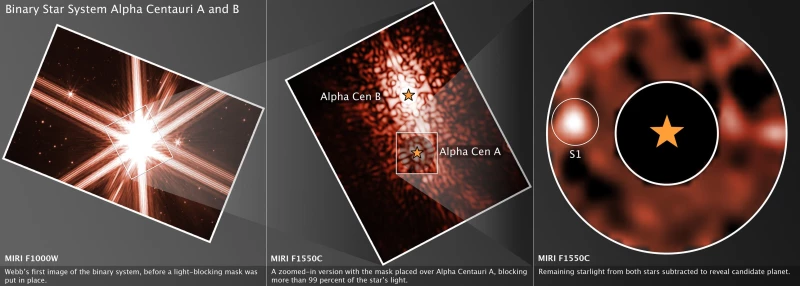
NASA/ESA/CSA/STSci/ A. Sanghi (Caltech)/C. Beichman (JPL)/D. Mawet (Caltech/ J. DePasquale (STScI)
That changed with the latest Webb observations. Detecting planets around a G2 star is tricky: such stars are bright, their habitable zones are farther out, and planets there take longer to orbit, all of which makes spotting them far harder than detecting planets around dimmer, closer-in red dwarfs.
Cutting-Edge Techniques to Remove Starlight
To tackle this, researchers used coronagraphic imaging to block out Alpha Centauri A’s light, along with scattered light from Alpha Centauri B. They referenced a similar but solitary star to model and subtract unwanted light interference, then filtered out asteroids, satellites, and distant galaxies that could create false positives.
Initial observations in August 2024 hinted at a planet, but it disappeared in follow-up sessions in February and April 2025. The team then ran millions of computer simulations to find an orbital path that could explain both the sighting and its disappearance — likely due to the planet being too close to the star to detect during certain periods.
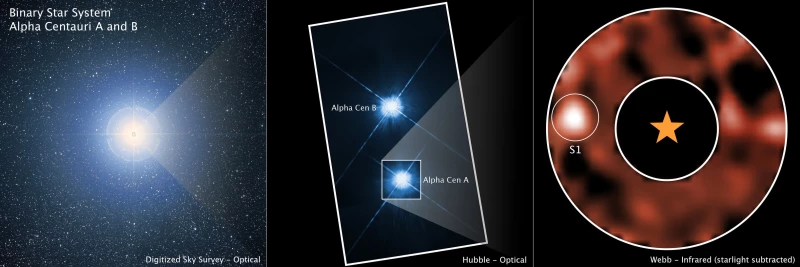
NASA/ESA/CSA/STSci/ A. Sanghi (Caltech)/C. Beichman (JPL)/D. Mawet (Caltech/ J. DePasquale (STScI)
If confirmed, the planet appears to be a gas giant similar in size to Saturn or Jupiter, orbiting within the star’s habitable zone with a surface temperature around 225 K (-48 °C / -55 °F) and completing an orbit every two to three Earth years. While it’s unlikely to host life itself, the possibility of habitable moons or other nearby planets remains open.
Finding such a world so close to home excites scientists, as it would offer unparalleled opportunities to study an alien planetary system. As Charles Beichman from NASA’s Jet Propulsion Laboratory put it, these observations are incredibly challenging — even for the Webb telescope — due to the brightness, proximity, and motion of the stars. Yet, a custom observation strategy made it possible, yielding results that could bring us closer to understanding our cosmic neighborhood.
Read the original article on: New Atlas
Read more: Study Maps Our Solar System’s Path Through a Gigantic Galactic Wave

