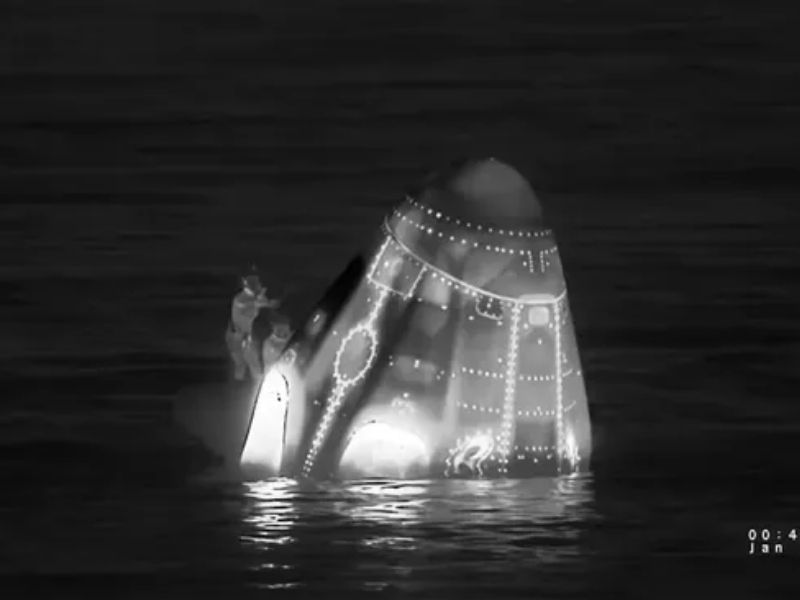

NASA footage showed four International Space Station crew members splashing down in the Pacific Ocean on Thursday following the first-ever medical evacuation in the station’s history.
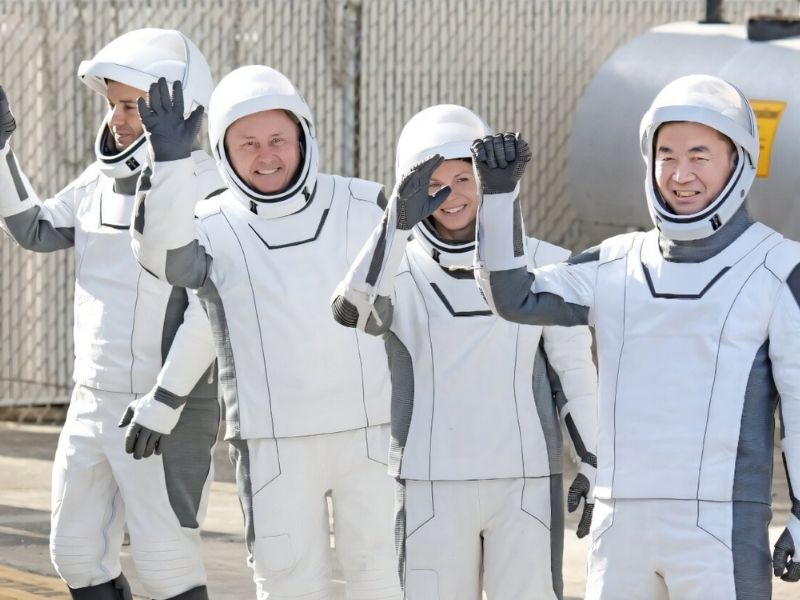
NASA video showed the capsule carrying American astronauts Mike Fincke and Zena Cardman, Russian cosmonaut Oleg Platonov, and Japanese astronaut Kimiya Yui touching down off the coast of San Diego at 12:41 a.m. (0841 GMT).
Their mission was ended early due to a health concern after five months in orbit.
Crew Member Stable; Return Not an Emergency, NASA Confirms
The U.S. space agency did not provide details about the issue but emphasized that the return was not an emergency.
The crewmember involved “was and remains in stable condition,” NASA spokesperson Rob Navias said on Wednesday.
Earlier this week, SpaceX Crew-11 pilot Fincke wrote on social media, “Above all, everyone is OK. All crew members are stable, safe, and receiving good care.”
He said they decided to ensure proper medical assessments could be conducted on Earth, where full diagnostic resources are available, and called it the right choice despite the disappointment.
The four Crew-11 astronauts arrived at the ISS in early August and planned to stay until mid-February, when the next crew would take over.
NASA Chief Health and Medical Officer James Polk said NASA brought the crew home ahead of schedule because of a ‘lingering risk‘ and uncertainty surrounding the medical diagnosis.
Meanwhile, American astronaut Chris Williams and Russian cosmonauts Sergey Kud-Sverchkov and Sergei Mikaev, who reached the station in November aboard a Russian Soyuz spacecraft, stayed on the ISS.
NASA and Russia’s Roscosmos jointly operate the space station, with each agency alternating responsibility for transporting one of the other nation’s citizens to and from orbit—one of the few remaining areas of cooperation between the United States and Russia.
Prepared for the Unexpected
Since 2000, astronauts have continuously occupied the International Space Station, which highlights international collaboration by uniting Europe, Japan, the United States, and Russia.
Orbiting about 400 kilometers (248.5 miles) above Earth, the ISS serves as a research platform to support future deep-space exploration, including planned missions back to the Moon and eventually to Mars.
Senior NASA official Amit Kshatriya said the four evacuated astronauts trained to respond to unforeseen medical issues and commended how they handled the situation.
NASA plans to retire the ISS after 2030 and will slowly lower its orbit until it disintegrates in the atmosphere over a remote area of the Pacific Ocean called Point Nemo, a designated spacecraft graveyard.
Read the original article: Phys.Org
Read more: Astronauts Splash down on Earth after a Space Station Medical Evacuation