Tag: JWST

  • JWST Verifies Coldest Exoplanet Found Around A Dead Star

    JWST Verifies Coldest Exoplanet Found Around A Dead Star

    In 2020, astronomers discovered WD 1856+534 b, a gas giant about 81 light-years from Earth. With about six times Jupiter’s mass, this “super-Jupiter” became the first known exoplanet to transit a white dwarf.
    Credit: Pixabay

    In 2020, astronomers discovered WD 1856+534 b, a gas giant about 81 light-years from Earth. With about six times Jupiter’s mass, this “super-Jupiter” became the first known exoplanet to transit a white dwarf.

    JWST Observations Confirm WD 1856+534 b as the Coldest Exoplanet Ever Detected

    In a recent study, an international team of astronomers reported their observations of the exoplanet WD 1856+534 b using the James Webb Space Telescope  Mid-Infrared Instrument (MIRI). They confirm that it is the coldest exoplanet ever detected.

    Acording to the research was led by  Mary Anne Limbach an Assistant Research Scientist in the Department of Astronomy at the University of Michigan, Ann Arbor, with collaborators from institutions including MIT’s Kavli Institute, Johns Hopkins University Applied Physics Lab, University of Victoria, University of Texas at Austin, CIERA, Centre for Astrophysics at the University of Southern Queensland, NSF NOIRLab, and the Gemini Observatory.

    The team conducted the observations as part of the JWST Cycle 3 General Observation (GO) program, which aimed to directly study the planet using Webb’s advanced infrared imaging and spectroscopic tools.

    This aligns with one of JWST’s core goals: to analyze exoplanets through the  Direct Imaging Method. This technique captures reflected light from a planet and analyzes it with spectrometers to identify chemicals.

    Credit: Direct Imaging consists of blocking the light of stars to detect light reflected by orbiting planets. (Marois et al., Nature, 2010)

    JWST’s Role in Detecting Biosignatures Beyond Our Solar System

    This approach helps astronomers detect possible biosignatures like oxygen, methane, and water, and understand a planet’s composition and formation.

    Powerful telescopes like JWST could eventually reveal the first evidence of life beyond our Solar System.

    Therefore, emission spectra from exoplanets can also provide valuable information about their chemical makeup and migration patterns.

    However, researchers note that a host star’s brightness often drowns out an exoplanet’s light.

    Consequently, direct imaging has mostly targeted large planets—such as gas giants—with wide orbits or very hot atmospheres. So far, scientists have not directly observed any rocky (terrestrial) exoplanets in close orbits around their stars.

    So far, scientists haven’t found any exoplanets with emission spectra below 275 K—similar to Earth’s temperature. White dwarf stars offer a rare chance to find and study these colder planets. As the researchers highlighted:

    “The faint luminosity of white dwarfs greatly lessens the contrast issues that usually complicate direct detection around main-sequence stars. As the remnants of stars like the Sun, white dwarfs give us a glimpse into the future of planetary systems after stellar death. Studying how planets interact with and endure the post-main-sequence phase is key to understanding orbital stability, dynamical migration, and the potential for planetary engulfment.”

    Moreover, studying planetary systems around white dwarfs can help determine if planets can survive this advanced stage of stellar evolution and whether habitable conditions could persist around stellar remnants.

    Limbach and Team Use JWST’s MIRI to Confirm WD 1856+534 b

    Astronomers and astrobiologists are eager to explore these questions using Webb’s advanced capabilities. For their research, Limbach and her team confirmed the existence of WD 1856+534 b by employing the Infrared (IR) excess method with data from JWST’s Mid-Infrared Instrument (MIRI).

    This method enabled the team to determine the mass of WD 1856+534 b and assess its atmospheric temperature. Their analysis showed an average temperature of 186 K (-87 °C; -125 °F), making it the coldest exoplanet ever discovered.

    They also confirmed that the planet’s mass is no more than six times that of Jupiter, compared to earlier estimates of 13.8 Jupiter masses.

    Their findings provide the first direct evidence that planets can survive and migrate into close orbits within the habitable zones of white dwarfs.

    The team is eager for upcoming observations of WD 1856 b by the JWST, set for 2025. These additional observations may help identify more planets and determine if WD 1856 b was disturbed into its current orbit.

    Moreover, results from earlier observations made by Webb’s Near-Infrared Spectrograph (NIRSpec) during Cycle 1 will be released soon, offering an initial analysis of the planet’s atmosphere.


    Read the original article on: Sciencealert

    Read more: Hubble Space Telescope Detects Water Vapor in Atmosphere of Small Exoplanet

  • What We’ve Learned From the JWST Three Years After Its Launch

    What We’ve Learned From the JWST Three Years After Its Launch

    The JWST image of NGC 628. The new Webb image of NGC 628. (Judy Schmidt/Flickr, CC BY 2.0)

    Three years ago, the James Webb Space Telescope (JWST) launched, marking a monumental moment in space exploration. As the largest and most powerful space telescope ever built, it has redefined our understanding of the Universe in just a short time.

    From exploring our Solar System to analyzing exoplanet atmospheres for signs of life and delving into the early Universe to uncover its first stars and galaxies, JWST has achieved remarkable breakthroughs. Here’s what we’ve learned—and the new questions that have emerged.

    JWST has pushed the boundaries of cosmic observation, capturing light from galaxies that formed when the Universe was just 300 million years old. Among these, a record-breaking galaxy managed to grow to 400 million times the mass of the Sun in a shockingly short time, highlighting the extraordinary efficiency of early star formation.

    These ancient galaxies defy expectations. While mature galaxies tend to appear red due to accumulated dust, JWST revealed them to be bright blue and dust-free. Theories suggest intense star radiation or massive supernovae could have swept away the dust, but their true nature remains a puzzle.

    Unusual Chemistry in Early Galaxies

    JWST has uncovered surprising chemical compositions in these early galaxies. Unlike modern stars, they are nitrogen-rich but have lower amounts of other metals. This discovery challenges existing models of chemical evolution and suggests unknown processes shaped the early Universe’s building blocks.

    Different chemical elements observed in one of the first galaxies in the Universe uncovered by JWST.
    (Adapted from Castellano et al., 2024 The Astrophysical Journal; JWST-GLASS and UNCOVER Teams)

    Using gravitational lensing from massive galaxy clusters, JWST has located faint galaxies that emit four times more high-energy photons than anticipated. These small galaxies may have played a pivotal role in ending the cosmic “dark ages,” when the Universe transitioned from opaque to transparent.

    One of JWST’s earliest images revealed an unexpected phenomenon: compact, red-colored objects emitting light at extreme velocities. Initially thought to be dense galaxies, these objects exhibit signs of supermassive black holes yet lack expected X-ray emissions. They also show star-like characteristics, suggesting a hybrid nature. This discovery could illuminate how supermassive black holes and stars evolved together in the early Universe.

    Rectangles highlight the apertures of JWST’s near infrared spectrograph array, through which light was captured and analysed to unravel the mysteries of the galaxies’ chemical compositions. (Atek et al., 2024, Nature)

    Impossibly Massive Early Galaxies

    JWST has identified massive galaxies—rivaling the Milky Way—that formed within the first 700 million years after the Big Bang. These findings challenge current models of galaxy formation, which struggle to explain how such colossal structures emerged so early. Cosmologists are now debating whether adjustments to existing theories or entirely new frameworks, possibly involving dark matter, are needed.

    In its brief operational history, JWST has already exposed gaps in our understanding of the cosmos. While we refine our models, the telescope promises to uncover even more unknowns. The enigmatic “red dots” were only the beginning—countless hidden wonders still await discovery in the vast expanse of space.

    In the background, the JWST image of the Pandora Cluster (Abell 2744) is displayed, with a little red dot highlighted in a blue inset. The foreground inset on the left showcases a montage of several little red dots discovered by JWST. (Adapted from Furtak et al., and Matthee et al., The Astrophysical Journal, 2023-2024; JWST-GLASS and UNCOVER Teams)

    Read Original article: Science Alert

    Read More: New Research Reveals the Moon Is Older Than Previously Believed

  • JWST Takes Detailed Picture of The Horsehead Nebula’s Features

    JWST Takes Detailed Picture of The Horsehead Nebula’s Features

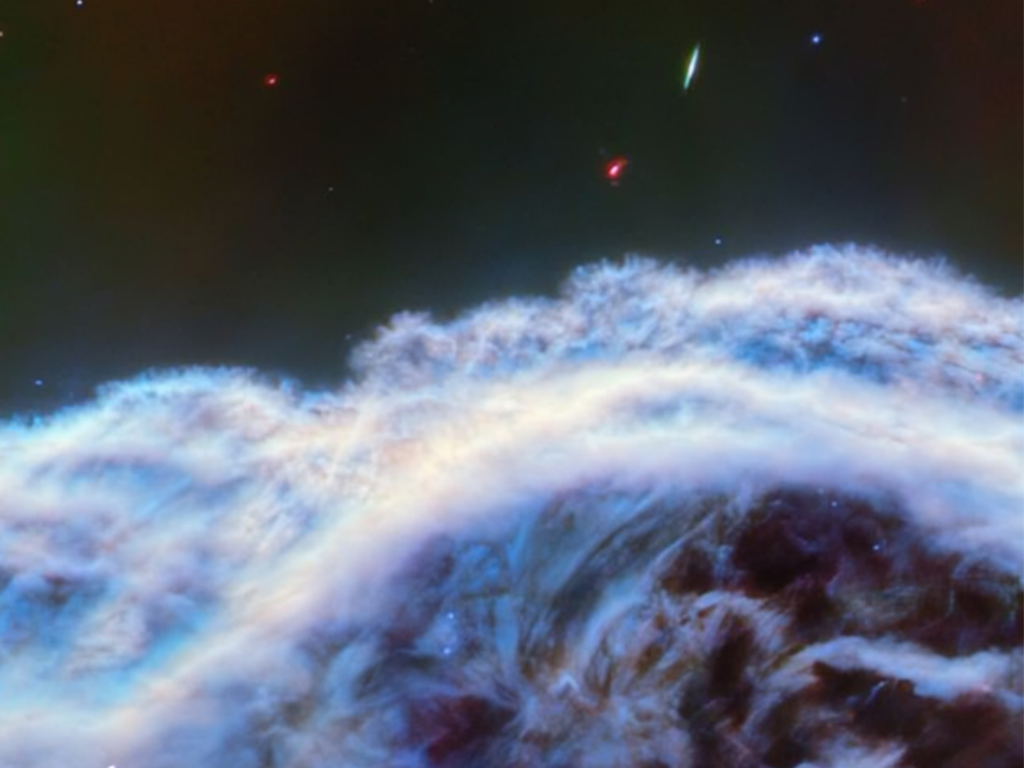
    JWST captured a near-infrared image of the boundary of the Horsehead Nebula.
    JWST captured a near-infrared image of the boundary of the Horsehead Nebula. (Credit: ESA/Webb, NASA, CSA, K. Misselt/University of Arizona, and A. Abergel/IAS/University Paris-Saclay/CNRS)

    A fresh perspective has just unveiled a renowned feature in our planet’s sky.

    Mid- and near-infrared investigations conducted by the James Webb Space Telescope have revealed never-before-seen characteristics in the Horsehead Nebula space cloud. The space telescope focused on the area on top of the “horse’s” head, collecting tendrils and filaments with exceptional resolution, producing an incredibly detailed image.

    Revealed Features and Characteristics

    By employing 23 filters together, a group of astronomers attained remarkable clarity. This allowed them to monitor emissions from particles smaller than 20 nanometers, such as interstellar polycyclic aromatic hydrocarbons. They could also observe the light reflected by larger particles and detect ionized hydrogen within the cloud.

    In near-infrared, the Horsehead Nebula. (Credit: ESA/Webb, NASA, CSA, K. Misselt/University of Arizona, and A. Abergel/IAS/University Paris-Saclay/CNRS)

    Implications for Astrophysical Understanding

    The Horsehead Nebula, a separate cloud located 1,300 light-years away and a component of the Orion molecular cloud complex, got its name from the fact that it resembles a horse’s head. It is so dense with gas and dust that it appears black in optical light, much like shadows. The cloud can be seen as a hole in the surrounding bright gas in several images.

    When you get close up or observe the nebula at wavelengths outside the range of normal human eyesight, it changes from looking like a pitch-black nothingness to a luminous, billowing cloud. The Horsehead Nebula is heated by the neighboring complex known as Sigma Orionis, which comprises a system of very young, massive, hot stars that burn at temperatures of about 34,600 Kelvin. The Horsehead Nebula does not have an internal light source.

    JWST captured an image of the nebula area. (Credit: ESA/Webb, NASA, CSA, K. Misselt/University of Arizona, and A. Abergel/IAS/University Paris-Saclay/CNRS, Mahdi Zamani The Euclid Consortium, Hubble Heritage Project/STScI AURA)

    Because of these characteristics, the Horsehead Nebula is an excellent laboratory for studying star nurseries. The ‘horsehead’ is a compact, gravitationally collapsed mass of material that contains tiny, still-forming stars hidden from the dust.

    Future Directions and Scientific Significance of the JWST Photos

    However, the surrounding material is severely harmed by the powerful radiation from the stars outside the nebula. Molecules breaking apart under the intense rays of far-ultraviolet light, a process known as photodissociation, create a field of mainly neutral interstellar medium. Therefore, the JWST photos will aid in probing the so-called photodissociation region (PDR) surrounding the Horsehead Nebula.

    The mechanism of photoevaporation, in which gas is ionized by intense light and successfully evaporates, can also be better understood with the aid of these new data.

    The nebula as seen by JWST in mid-infrared. (Credit: ESA/Webb, NASA, CSA, K. Misselt/University of Arizona, and A. Abergel/IAS/University Paris-Saclay/CNRS)

    Thus far, the photos have enabled a group of scientists to distinguish between a network of filaments perpendicular to the front of the PDR and the small-scale features that adorn the illuminated border of the Horsehead Nebula. This network contributes to the photoevaporative flow by containing gas and dust.

    Still, this is only the beginning. The next stage is to thoroughly examine the light emitted to determine the chemical makeup of the dust and gas and the size and flow of the dust grains based on light scattering. This will make it possible to create a thorough model of the dust evolution in the PDR and aid in understanding how these clouds evolve and eventually evaporate, releasing the trapped nascent stars.


    Read the original article on: ScienceAlert

    Also read: Sodium Batteries Sans Lithium Move from Lab to US Manufacturing