Replicating the touch and sensitivity of human skin—known as robotic touch—might not require advances in flexible electronics or the integration of thousands of miniature sensors.
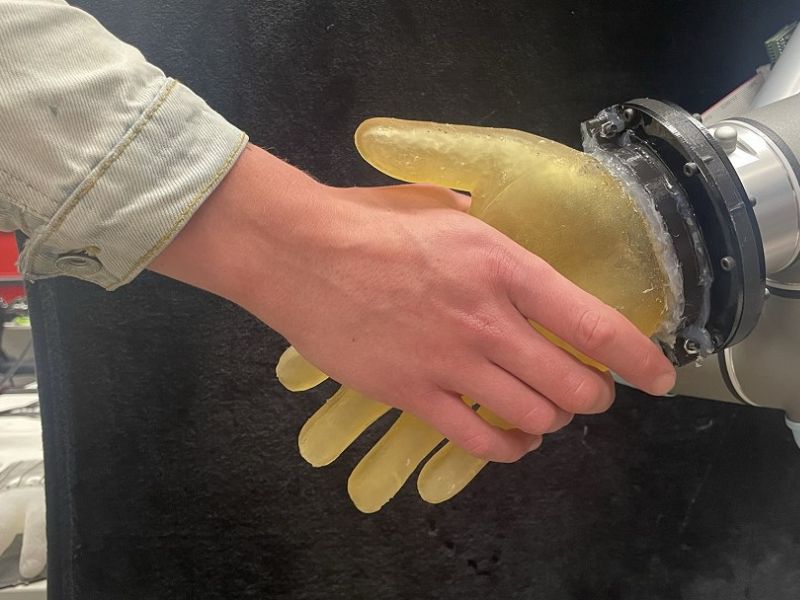
Researchers have developed a new type of robotic skin that is low-cost, durable, and highly sensitive. This innovative skin delivers exceptional precision and fits onto robotic hands like a glove.
Moldable Conductive Polymer Offers Versatile Foundation for Robotic Skin
David Hardman and his team at the University of Cambridge and University College London created a conductive polymer they can melt and mold into complex shapes.
Although it doesn’t match the sensitivity of human skin, the material can process signals from over 860,000 microscopic channels, enabling it to detect various types of touch and pressure—such as a finger’s contact, temperature differences, cuts or punctures, and multiple simultaneous touches.
Remarkably, all of this is achieved using a single material, greatly simplifying the design. By reading physical inputs, this tech helps robots interact more like humans.
Image Credits: University of Cambridge
Most current robotic touch technologies rely on small, localized sensors and require separate components to detect different kinds of touch. In contrast, the newly developed electronic skin functions as a single, unified sensor—closer in function to human skin.
One Material, Many Sensations
“Using different sensors for each type of touch makes the manufacturing process more complex,” explained David Hardman. “Our goal was to create a single material that could detect multiple types of touch at once.”
The researchers achieved this using a sensor material capable of multimodal sensing—responding differently to various forms of touch. Though pinpointing each signal is tricky, the materials are easier to make and more durable.overall.
To interpret the signals, the team experimented with different electrode layouts to identify which configuration yielded the most detailed data. With only 32 wrist electrodes, they collected over 1.7 million data points from the hand via the material’s fine conductive network.
From Gentle Contact to Physical Damage
They tested the prototype with a variety of stimuli, including light touch, multiple simultaneous touches, heat exposure from a heat gun, and physical damage from a scalpel. Data collected from these tests was then used to train a machine learning model that can accurately interpret future touch inputs.
Robotic skin hasn’t yet matched human capabilities, said Professor Thomas Thuruthel, but this is the most advanced and easiest to produce so far—and it works well across real-world tasks.
Researchers are working to identify new semiconductor materials that could enhance the performance of solar cells and electronic devices. However, progress is slowed by the time-consuming process of manually measuring key material properties.
Accelerating Discovery with Autonomous Photoconductance Testing
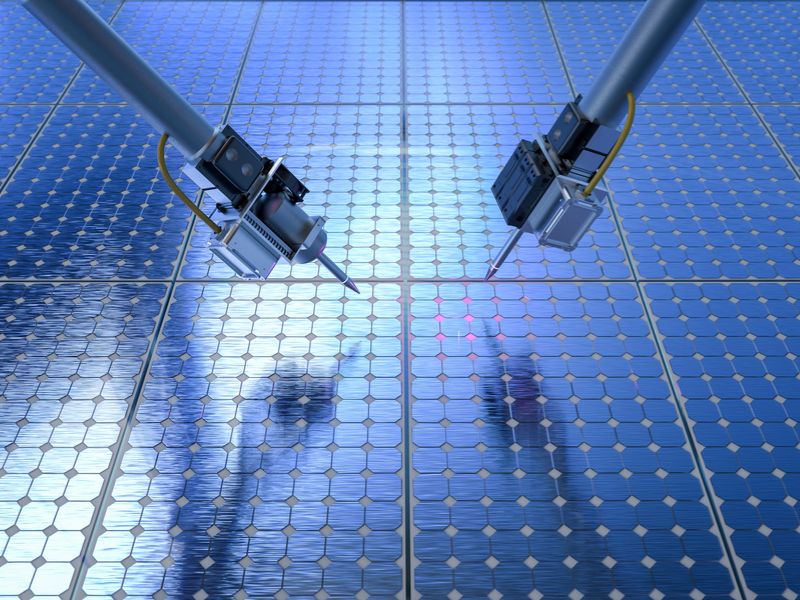
To accelerate this process, MIT scientists have created a fully autonomous robotic system. This system employs a robotic probe to assess photoconductance—a crucial electrical property that indicates how a material responds to light.
By integrating expert knowledge from materials science into the machine-learning model that directs the robot’s actions, the system can determine the most informative spots to probe. A custom planning algorithm then calculates the most efficient route between these points.
Over a 24-hour period, the fully autonomous robotic probe recorded over 125 distinct measurements each hour, delivering greater accuracy and consistency than other AI-driven techniques.
By significantly accelerating how quickly researchers can analyze critical characteristics of new semiconductor materials, this approach could help advance the development of more efficient solar panels.
“This paper is particularly exciting because it outlines a clear route for autonomous, contact-based measurement techniques,” says mechanical engineering professor Tonio Buonassisi, senior author of the study. Measuring all essential material properties often requires making physical contact. When contact is necessary, speed and data richness become crucial.
The research team includes lead author and graduate student Alexander (Aleks) Siemenn, postdoctoral researchers Basita Das and Kangyu Ji, and graduate student Fang Sheng. The researchers publish their findings today in Science Advances.
Establishing Contact
Since 2018, researchers in Buonassisi’s lab have been working toward creating a fully autonomous lab for materials discovery. More recently, their efforts have centered on identifying new perovskites—a type of semiconductor commonly used in solar panels.
In earlier projects, they developed methods for quickly synthesizing and printing unique perovskite combinations, along with imaging techniques to assess key material properties.
However, the most precise way to measure photoconductance involves placing a probe directly on the material, illuminating it, and recording its electrical reaction.
“To make our lab operate as efficiently and accurately as possible, we needed a solution that could deliver high-quality measurements while keeping the overall testing time to a minimum,” explains Siemenn.
This required combining machine learning, robotics, and materials science into a single autonomous system. The process starts with the robot using its built-in camera to capture an image of a slide containing the printed perovskite material.
Next, computer vision breaks the image into sections, which are analyzed by a neural network trained to integrate expert knowledge from chemists and materials scientists.
Blending Human Expertise with Robotic Precision for Smarter Measurements
“Robots can enhance the consistency and accuracy of our experiments, but human oversight remains essential. Without effectively embedding the deep insights of chemical experts into these systems, we won’t succeed in discovering new materials,” Siemenn notes.
The model applies this expert input to identify the best locations for the probe to make contact, based on the sample’s shape and composition. These contact points are then processed by a path-planning algorithm that calculates the most efficient route for the probe to follow.
This machine-learning method is especially valuable because the printed samples vary in shape—ranging from round droplets to irregular, jellybean-like forms.
“It’s a bit like trying to measure snowflakes finding two exactly alike is nearly impossible,” says Buonassisi.
Once the optimal path is identified, the system sends commands to the robot’s motors, which move the probe and rapidly collect measurements at each contact point.
The system’s speed largely comes from the neural network’s self-supervised learning. It selects the best contact points directly from the sample image, without requiring pre-labeled data.
The researchers also sped things up by improving the path planning algorithm. Interestingly, introducing a small degree of randomness allowed it to discover shorter, more efficient paths.
“As autonomous labs advance, it becomes essential to combine hardware engineering, software development, and materials science expertise within one team. That integration is a key ingredient to fast innovation,” Buonassisi explains.
Comprehensive Data, Swift Outcomes
After constructing the system from scratch, the researchers evaluated each of its components. They found that their neural network identified optimal contact points more efficiently and with less computational effort than seven other AI techniques. Additionally, the path planning algorithm consistently produced shorter routes compared to alternative methods.
When integrated into a fully autonomous 24-hour experiment, the robotic system performed over 3,000 distinct photoconductance measurements—averaging more than 125 per hour.
This high-precision approach also allowed the team to detect zones with elevated photoconductance and regions where the material had begun to degrade.
“Capturing such detailed data at high speeds and without human intervention paves the way for discovering and designing new, high-efficiency semiconductors—particularly for sustainable technologies like solar panels,” says Siemenn.
The team plans to further advance this robotic system as part of their goal to develop a fully autonomous materials discovery laboratory.
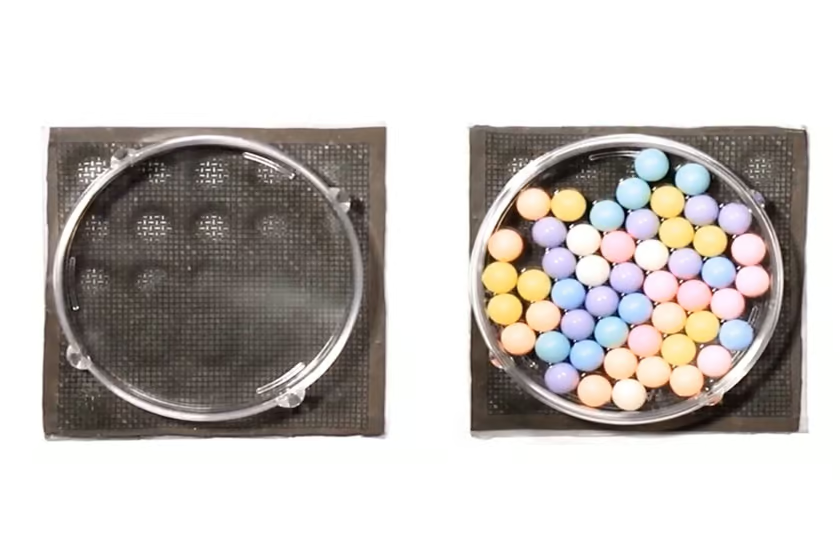
The metasheet demonstrates its ability to move objects – in this case, rotating Petri dishes Yinding Chi
Scientists at North Carolina State University (NCSU) have developed a magnetic “metasheet” capable of moving objects and liquids without the need for robotic arms or grippers.
The device consists of a sheet made of elastic polymer with magnetic microparticles embedded in it. They etch a kirigami pattern of tessellating triangles into the surface, providing greater flexibility for controlled deformations.
How the Magnetic Field Manipulates the Metasheet
The idea is that by moving a magnetic field beneath the metasheet, different areas of it will rise or fall.For example, they can create a depression by making the magnetic field attractive to the particles and form a hill by making it repellent. The system responds in as little as two milliseconds.
“You can make the surface of the metasheet move like a wave by controlling the direction of the magnetic field,” said Jie Yin, co-author of the study. “Adjusting the strength of the magnetic field determines how much the wave rises or falls.”
Demonstrating the Metasheet’s Capability to Move Objects
Using this mechanism, they can remotely control the metasheet to move objects by raising and lowering different areas.The team demonstrated this with a variety of non-magnetic objects, such as small beads, a glass slide, a wooden plate, a leaf, and even water droplets using a superhydrophobic version of the material. In all cases, the team could roll and move these items to specific locations through controlled sequences of the magnetic field.
The researchers state that this approach could be useful for moving fragile objects or those with shapes that are unsuitable for robotic arms, grippers, and other systems. The next steps involve scaling the technique, and the scientists also see other potential applications in the future.
Yin said, “We are also interested in using this approach to create haptic technologies, with applications ranging from gaming to accessibility devices.”
Magnetic kirigami dimpled sheet for morphing and manipulation
In 80 hours, Microsoft’s AI tool narrowed 32 million theoretical materials to 18, leading scientists to synthesize one that can decrease lithium usage in batteries by 70%.
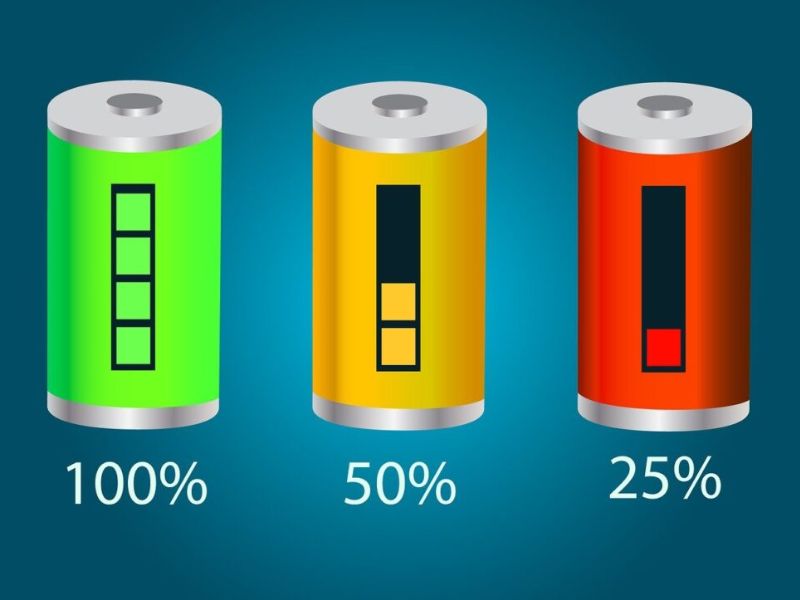
An AI program has pinpointed a synthetic material, absent in nature, that can potentially decrease lithium usage in batteries by as much as 70%.
Out of 32 million candidates, the optimal choice was identified as a mixed metal chloride consisting of sodium, lithium, yttrium, and chloride ions.
However, rechargeable batteries primarily rely on lithium as the vital component, and the demand for this metal has surged in recent years. Unfortunately, the energy-intensive mining process for lithium often results in enduring water and land pollution. Consequently, numerous companies are actively seeking alternative materials for battery construction.
To accomplish this, Microsoft and the Pacific Northwest National Laboratory (PNNL) collaborated to develop a screening tool for potential new materials that could be used in low-lithium batteries using Microsoft’s Azure Quantum Elements tool. The researchers published their results on January 8 via the pre-print server arXiv.
Building a new type of battery
Batteries transport charged particles between positive and negative terminals, called electrodes. When wires connect lithium ions from the negative electrode to the electrolyte, reaching the positive electrode. Simultaneously, electrons move through the wires in the same direction, facilitating energy extraction from the battery.
In this investigation, the scientists concentrated on solid electrolyte materials, aiming to create a safer and more effective substitute for the existing liquid electrolytes. The crucial requirement is that the electrolyte material should align with the electrodes, permitting smooth passage of lithium ions while entirely hindering the movement of electrons within the battery.
Narrowing Down 32 Million Candidates for Novel Battery Material
The researchers initiated the process with over 32 million potential candidates, generated by swapping various elements into existing electrolyte structures. They employed a combination of AI techniques to filter the materials, considering their properties in the selection process.
In fact, Kandler Smith, a mechanical engineer from the National Renewable Energy Laboratory, explained to Live Science that a substantial portion of the candidate materials, generated through theoretical computer calculations, is typically not stable enough for practical laboratory synthesis. He mentioned that their initial emphasis was on filtering for stability, and this preliminary screening swiftly reduced the pool from 32 million to half a million materials within hours.
AI-driven Criteria Refine Material Choices for Accelerated Research
The team then selected nine additional standards. It employed AI to systematically apply them, arranging the candidates based on their electronic characteristics, cost, and strength. This process narrowed the selection to 18 finalists. Smith expressed his admiration, stating, “I was very impressed that they accomplished all this in just 80 computer hours — experimenting with all those materials would have taken 20 years. Their machine learning approach, paired with physics-based molecular dynamics models, is a significant advancement and will greatly accelerate research.“
The scientists produced a set of final materials comprising lithium, sodium, the rare earth element yttrium, and chloride ions in different ratios. Notably, the combination of lithium and sodium in this material enables the conduction of both ion types, a previously considered impossible phenomenon. This material could potentially function in sodium-ion batteries as well. Noteworthy is a high-sodium variant that contained 70% less lithium than a standard battery, suggesting a significant potential for reducing the cost and environmental impact of these batteries in the future.
A starting point for AI-powered material discovery
The team subsequently assessed the electronic properties of the candidates. Smith explained that the key property of an electrolyte is ionic conductivity, which is how fast the lithium ions can move. He noted that this factor determines the charging speed of the battery, and it is crucial for electric vehicles.
Regular lithium-ion batteries utilize a liquid organic solvent electrolyte, enabling fast ion movement and charging. However, these solvents are flammable, and interactions with the electrodes cause battery degradation over time. According to Smith, solid-state electrolytes have the advantage of being more chemically stable and much less flammable. The downside is that they move the lithium ions slowly, resulting in slower charging times.
Breakthrough Discovery
The AI pinpointed the top-performing candidate, an order of magnitude less conductive than current liquid electrolytes. This translates to a significant difference in charge time, from 30 minutes to five hours. Therefore, the material’s electronic performance improvements are necessary before it becomes practical for applications. Nevertheless, Microsoft representatives mentioned in an email to Live Science that the researchers successfully constructed a working prototype from the final material and used it to power a lightbulb.
Smith views it as a solid initial step. He emphasized that the work’s most significant accomplishment was streamlining material discovery through AI. He explained that the same machine learning pipeline could be beneficial in supporting research across hundreds of other related areas.
According to Brian Abrahamson, PNNL’s chief digital officer, both Microsoft and PNNL show a keen interest in exploring this further in the future. Abrahamson stated that the new battery results are just one example — a proof point. He mentioned that they recognized early on that the key lies in the speed of AI assisting in identifying promising materials and their ability to implement those ideas in the laboratory promptly. He added that they plan to push the boundaries of what’s possible by fusing cutting-edge technology and scientific expertise.
A team of scientists from the Ames National Laboratory has unveiled a groundbreaking machine learning model designed to identify critical-element-free permanent magnet materials.
This novel model is a predictive tool for assessing the Curie temperature of fresh material combinations, marking a pivotal advancement in the application of artificial intelligence to forecast new permanent magnet materials. This development follows the team’s recent achievement in uncovering thermodynamically stable rare earth materials.
The Significance of High-Performance Magnet
High-performance magnets are indispensable for various technologies, including wind energy, data storage, electric vehicles, and magnetic refrigeration.
These magnets often contain critical materials like cobalt, Neodymium, and Dysprosium—scarce resources in high demand. This scarcity has spurred researchers to seek innovative ways of designing magnetic materials that reduce reliance on critical elements.
Harnessing the Potential of Artificial Intelligence
Machine learning (ML), a facet of artificial intelligence, relies on data and iterative algorithms to enhance predictive capabilities continually.
The research team leveraged experimental data on Curie temperatures and theoretical modeling to train their ML algorithm. The Curie temperature signifies the maximum temperature at which a material retains its magnetic properties.
The Role of ML in Material Discovery
Yaroslav Mudryk, a scientist at Ames Lab and the research team’s senior leader, emphasized the importance of identifying compounds with high Curie temperatures.
These materials can sustain magnetic properties at elevated temperatures, making them crucial for designing permanent magnets and other functional magnetic materials.
Traditionally, the search for such materials relied on expensive and time-consuming experimentation. However, ML offers a more efficient and resource-saving alternative.
Building the ML Model on Scientific Foundations
Prashant Singh, a scientist at Ames Lab and a research team member, underscored the project’s focus on developing an ML model rooted in fundamental scientific principles.
The model was trained using known magnetic materials, establishing connections between various electronic and atomic structure attributes and Curie temperature. These patterns provide the ML model with a foundation for identifying potential candidate materials.
Putting the Model to the Test
To validate their model, the team experimented with compounds based on Cerium, Zirconium, and Iron—an idea proposed by Andriy Palasyuk, another scientist on the team. Their goal was to explore unknown magnet materials derived from readily available elements.
The success of the ML model in predicting the Curie temperature of these material candidates represents a significant stride toward creating a high-throughput method for designing future permanent magnets.
In the words of Prashant Singh, “We are writing physics-informed machine learning for a sustainable future.” This innovative approach could revolutionize how we discover and develop materials for sustainable and advanced technological applications.
Read more: New Algorithm Aces University Math Course Questions.
We use cookies on our website to give you the most relevant experience by remembering your preferences and repeat visits. By clicking “Accept All”, you consent to the use of ALL the cookies. However, you may visit "Cookie Settings" to provide a controlled consent.
This website uses cookies to improve your experience while you navigate through the website. Out of these, the cookies that are categorized as necessary are stored on your browser as they are essential for the working of basic functionalities of the website. We also use third-party cookies that help us analyze and understand how you use this website. These cookies will be stored in your browser only with your consent. You also have the option to opt-out of these cookies. But opting out of some of these cookies may affect your browsing experience.
Necessary cookies are absolutely essential for the website to function properly. These cookies ensure basic functionalities and security features of the website, anonymously.
Cookie
Duration
Description
cookielawinfo-checkbox-analytics
11 months
This cookie is set by GDPR Cookie Consent plugin. The cookie is used to store the user consent for the cookies in the category "Analytics".
cookielawinfo-checkbox-functional
11 months
The cookie is set by GDPR cookie consent to record the user consent for the cookies in the category "Functional".
cookielawinfo-checkbox-necessary
11 months
This cookie is set by GDPR Cookie Consent plugin. The cookies is used to store the user consent for the cookies in the category "Necessary".
cookielawinfo-checkbox-others
11 months
This cookie is set by GDPR Cookie Consent plugin. The cookie is used to store the user consent for the cookies in the category "Other.
cookielawinfo-checkbox-performance
11 months
This cookie is set by GDPR Cookie Consent plugin. The cookie is used to store the user consent for the cookies in the category "Performance".
viewed_cookie_policy
11 months
The cookie is set by the GDPR Cookie Consent plugin and is used to store whether or not user has consented to the use of cookies. It does not store any personal data.
Functional cookies help to perform certain functionalities like sharing the content of the website on social media platforms, collect feedbacks, and other third-party features.
Performance cookies are used to understand and analyze the key performance indexes of the website which helps in delivering a better user experience for the visitors.
Analytical cookies are used to understand how visitors interact with the website. These cookies help provide information on metrics the number of visitors, bounce rate, traffic source, etc.
Advertisement cookies are used to provide visitors with relevant ads and marketing campaigns. These cookies track visitors across websites and collect information to provide customized ads.