U.S. President Donald Trump will grant another 90-day extension to determine TikTok’s future, the White House announced on Tuesday. The previous extension, signed in April, was scheduled to expire on Thursday, June 19.
Trump to Issue New Executive Order to Keep TikTok Running
“President Trump will issue another Executive Order this week to allow TikTok to continue operating,” said White House Press Secretary Karoline Leavitt in a statement to CBS News.
“As he’s said many times, President Trump wants to keep TikTok running. This 90-day extension gives the Administration time to finalize the deal, so Americans can continue using TikTok, confident their data stays safe and secure,” she added.
TikTok officially launched TikTok for Artists on Tuesday, a new music insights platform aimed at helping artists grow their careers. The launch follows a two-month test phase in select countries.
The platform is designed to support artists and their teams in connecting with fans, enhancing promotion, and guiding content strategy on TikTok. It offers access to detailed data on how an artist’s music and posts are performing on the platform.
Metrics include views, post counts, and creator engagement for each song, as well as insights into post performance. It also provides demographic data about followers, such as age, language, and gender.
TikTok for Artists Provides Guides, Tools, and Additional Support
According to the company, TikTok for Artists also offers step-by-step guides to using TikTok’s tools and features, along with extra support and resources.
Image Credits:TikTok
TikTok also revealed a new “Pre-Release” feature that enables artists to promote upcoming albums on the platform. This tool allows fans to pre-save albums directly to their Spotify or Apple Music libraries, making the music instantly accessible upon release.
Given TikTok’s significant influence on music trends and viral hits, introducing tools to help artists boost promotion and fan interaction is a natural step. TikTok for Artists could play a key role in helping artists grow their audience and broaden their reach.
TikTok for Artists Launch Follows Shutdown of TikTok Music Streaming Service
The launch of TikTok for Artists follows ByteDance’s shutdown of TikTok Music eight months ago to focus on enhancing TikTok’s role in music discovery and streaming.
Over the past year, it’s clear that TikTok is shifting away from competing with services like Spotify and Apple Music, focusing instead on becoming a platform for music discovery and promotion.
TikTok for Artists is now available in over 25 countries, including the US, UK, Japan, Australia, Canada, and several in Europe, the Middle East, and Latin America. TikTok says the platform will expand to more countries soon.
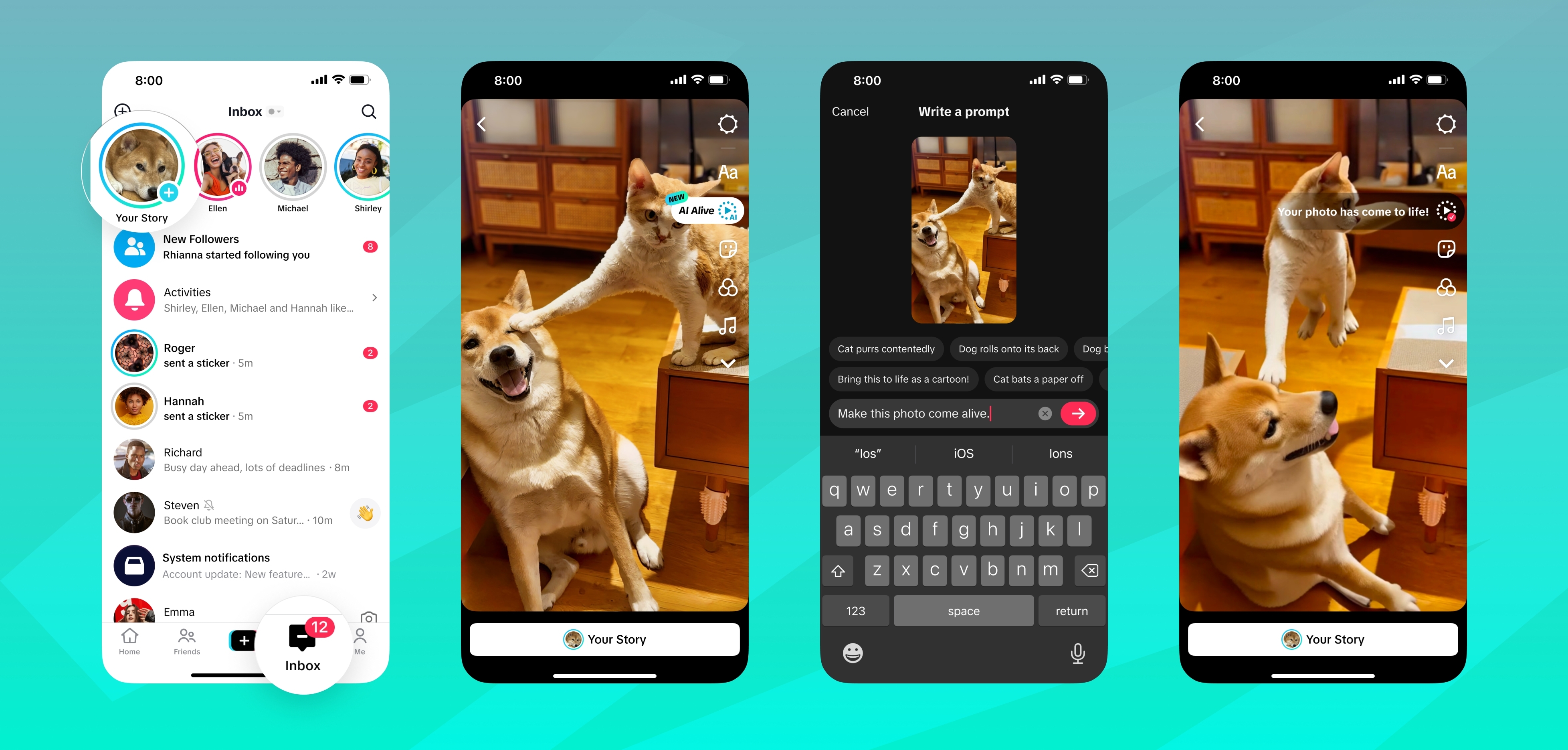
TikTok announced on Tuesday the launch of its first image-to-video AI feature, named “TikTok AI Alive,” which lets users convert static photos into videos within TikTok Stories.
According to TikTok, the feature is available exclusively through the Story Camera and uses AI to generate short-form videos with “movement, atmospheric, and creative effects.”
For example, if your photo includes the sky, clouds, and ocean, TikTok can transform it into a video where the sky slowly changes color, clouds move, and wave sounds play in the background. You could also animate a group selfie to emphasize gestures and facial expressions.
TikTok Advances AI Tools with Image-to-Video Feature, Outpacing Rivals
The introduction of TikTok’s new image-to-video feature follows its earlier release of an in-app text-to-image AI generator. While Instagram and Snapchat also provide text-to-image AI tools for creators, TikTok is advancing further by enabling users to turn images into videos. Notably, Snapchat has announced plans to offer AI video generation from images in the near future.
Credit:TikTok
AI Alive stories will include an AI-generated label to inform viewers that the content was created using artificial intelligence. Additionally, the videos will feature embedded C2PA metadata—a technical standard designed to help identify AI-generated content, even if the video is downloaded and shared outside of TikTok.
TikTok Ensures Safety with AI Features Through Trust and Safety Reviews
“We prioritize safety in everything we develop, including our AI features,” TikTok shared in a blog post. As this technology opens up new creative possibilities, it goes through several trust and safety reviews to safeguard our community. To prevent policy violations, our moderation system reviews the uploaded photo, the written AI prompt, and the AI Alive video before showing it to the creator.
TikTok states that users can report videos they believe violate the app’s rules, and the platform performs a final safety check after a creator posts an AI Alive story.
Creators can make an AI Alive video by opening the Story Camera and tapping the blue plus button on the Inbox or Profile page. Then, they can choose a photo from their Story Album and access the AI Alive icon on the editing page toolbar.
TikTok is shutting down its Instagram-like app, TikTok Notes, on May 8. The photo-sharing platform, which was launched for testing last year in Canada, Australia, and Vietnam, is being discontinued.
Users of TikTok Notes are being informed of the decision and redirected to ByteDance-owned Lemon8, a move that makes sense given the similarities between the two apps.
Enhancing Lemon8 with Insights from TikTok Notes
“We’re excited to bring the feedback from TikTok Notes to Lemon8 as we continue building a dedicated space for our community to share and experience photo content, designed to complement and enhance the TikTok experience,” a TikTok spokesperson told TechCrunch.
Although TikTok hasn’t given a specific reason for shutting down the app, it’s likely due to low adoption. Instead, the company appears to be shifting its focus to Lemon8, which had approximately 12.5 million global monthly active users as of December 2024.
In a message to TikTok Notes users, TikTok stated that the decision to shut down the app “was not made lightly.” The notice advises users to download and save their TikTok Notes data while encouraging them to “continue sharing your creativity on Lemon8.” TikTok describes Lemon8 as a lifestyle app that provides a similar experience to TikTok Notes but with “even more features.”
Lemon8’s Launch and Features
Lemon8 debuted in Japan in 2020 before expanding to the U.S. and Southeast Asian markets. The app combines elements of Instagram and Pinterest, allowing users to create slideshows, share photo collections, and explore content through “Following” and “For You” feeds. It also includes creative tools such as filters, effects, stickers, and text templates.
Although TikTok is promoting Lemon8 as a replacement for TikTok Notes, ByteDance has also positioned the app as a potential alternative to TikTok itself amid the threat of a U.S. ban.
In November, the company enabled users to log into Lemon8 using their TikTok accounts and introduced a feature allowing cross-sharing of photo content between the two apps. This strategy was seen as a way for ByteDance to seamlessly transition creators to the new platform without requiring them to sign up separately, providing an alternative in case TikTok were to be banned.
Now, with an April 5 ban deadline approaching, TikTok is continuing to promote Lemon8 within its app.
Skylight, a startup challenging TikTok with a more open alternative, is launching its mobile app to the public on Tuesday after just 10 weeks of development. Supported by Mark Cuban and other investors, Skylight joins a growing list of apps built on the AT Protocol—the same technology behind the social network Bluesky and several other emerging platforms.
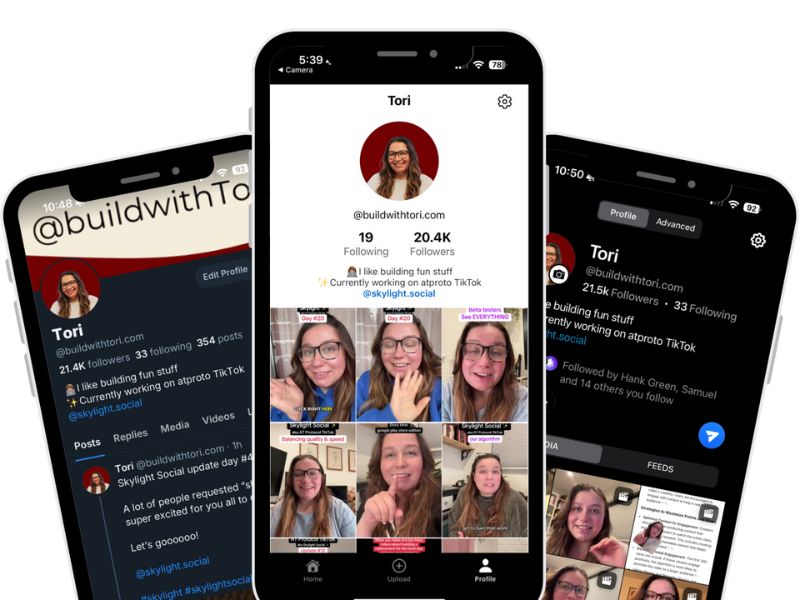
Co-founded by CEO Tori White and CTO Reed Harmeyer, Skylight delivers a short-form video experience with familiar features, including an in-app video editor, options to comment, like, and share videos, personalized user profiles, and the ability to follow others.
Since Skylight runs on the AT Protocol (also known as “ATProto“), users instantly connect with Bluesky’s network of over 33.8 million people. This integration allows videos shared on Skylight to reach and engage users across Bluesky and other ATProto-based apps, such as Flashes, a platform focused on photo content.
Early Funding and Support
The company is backed by a pre-seed funding round led by Cuban, who expressed earlier this year his desire to support a TikTok alternative based on the AT Protocol. The Graham & Walker Venture Fund, led by Leslie Feinzaig, also contributed to the investment.
White, a former travel influencer and self-taught software developer based in Seattle, explains that she and co-founder Harmeyer were motivated to create Skylight after hearing about the potential U.S. ban on TikTok.
To prepare for the ban, which is currently on hold, White had saved her TikTok videos but remained concerned about losing access to her community and comments. At the time, she and Harmeyer had already been experimenting with ATProto and recognized its potential.
Image Credits:Skylight Social
Confidence in ATProto’s Stability
“The first thing that caught our attention about ATProto was that Bluesky was actually working,” Harmeyer told TechCrunch at the ATmosphere Conference in Seattle in March. “We didn’t see the ‘fail whale,’” he added, referencing the error graphic from Twitter’s early days when the platform frequently crashed. “That gave us confidence in the technology behind it.”
Harmeyer and White soon recognized that this was the perfect opportunity to create a new social app on the protocol—one that could be “ban-proof.”
Drawing on her background as an influencer, White began sharing Skylight’s development journey on TikTok. This strategy helped generate awareness and attract a growing community of potential users.
Image Credits:Skylight Social
Building Awareness from Day One
“We started with distribution,” White explained. “I actually made a video before we even wrote a single line of code … so people could follow our journey as we built,” she told TechCrunch at the conference. “We realized, oh wow, we’re creating something we think is amazing, but no one knows about it yet. So we had to find a way to get people interested—because we knew there was a need for it,” she added.
Today, White’s TikTok account, @buildwithtori, has nearly 50,000 followers, many of whom became early testers of Skylight.
Similar to Bluesky, Skylight now allows video uploads of up to three minutes, an increase from its initial one-minute limit. However, White envisions Skylight evolving beyond just a decentralized TikTok alternative.
Image Credits:Skylight Social
She suggests that Skylight will eventually offer users more control over their feed, including new interactive gestures beyond traditional swiping and scrolling.
Additional upcoming features include support for sounds, duets, stitching, bookmarks, and playlists.
Currently in beta on the Google Play Store, the app has now launched publicly on Apple’s App Store following its initial testing phase.
Meta-owned Instagram is once again borrowing a feature from TikTok—this time, allowing users to play Reels at 2x speed by long pressing on either side of the screen.
TikTok’s Evolution in Video Length and Speed
When TikTok first launched, videos were limited to 15 seconds. As the platform grew in popularity, it expanded support for longer videos. To keep up with users’ fast-paced viewing habits, TikTok introduced a speed adjustment feature, enabling quicker content consumption.
Image Credits:Instagram
Instagram Reels Expands Video Length and Speed Controls
Instagram Reels initially limited videos to 15 seconds, but now users can upload clips up to three minutes long. With the new fast-forward feature, Instagram, like TikTok, aims to help users consume more content in less time.
The fast-forward feature increases the likelihood that viewers will reach the end of longer videos, aligning with Reels’ goal of delivering quick, bite-sized entertainment. This reflects broader concerns that the rise of short-form video may be diminishing attention spans and making it harder to engage with longer content.
Since Instagram Reels was designed as a direct competitor to TikTok, it’s no surprise that the platform continues to adopt similar features. This isn’t the first instance either—Instagram’s Remix tool closely mirrors TikTok’s Duet feature.
Around 1.8 billion people use TikTok monthly, spending an average of 95 minutes per day on the platform for entertainment, engagement, and even education. While these figures are impressive, a new study highlights that TikTok may not be the most trustworthy source for health-related information, especially regarding ADHD.
Study Reveals Misinformation in Popular TikTok ADHD Videos
Researchers from the University of British Columbia (UBC) analyzed the 100 most-viewed TikTok videos tagged with ADHD content and found that fewer than half aligned with professional diagnostic criteria.
These videos, which amassed nearly half a billion views, were primarily based on personal experiences and opinions. Many failed to capture the complexity of ADHD, including how symptoms can vary among individuals.
The researchers looked at hashtags related to ADHD posts. (Karasavva et al., PLOS One, 2025)
“While TikTok is a powerful platform for raising awareness and reducing stigma, it also has its drawbacks,” says UBC clinical psychologist Vasileia Karasavva.
“Personal experiences and anecdotes can be compelling, but without proper context, they risk spreading misconceptions about ADHD and mental health overall.”
Examining the Influence of Accurate and Inaccurate ADHD Content on Student Perceptions
To explore this impact, researchers conducted an experiment using the five most accurate and five least accurate videos from the top 100, as assessed by clinical psychologists. These 10 videos were shown to 843 undergraduate students in an introductory psychology course, who then rated them based on their perceived educational value.
While psychologists rated the five most accurate videos at an average of 3.6 for accuracy, students gave them a lower score of 2.8. Meanwhile, the least accurate videos received a 1.1 rating from psychologists but scored 2.3 among students.
This gap highlights a concerning disconnect between expert evaluations and how casual viewers perceive ADHD content on TikTok. Such misinformation could influence public understanding of the condition, potentially impacting diagnoses and treatment.
“Our findings reveal a discrepancy between mental health professionals and young adults regarding the educational value of ADHD content on TikTok,” the researchers note. “Addressing this is essential for improving access to treatment and support for individuals with ADHD.”
The study also found that students who frequently viewed ADHD-related content were more likely to share it and overestimate the condition’s prevalence.
The researchers emphasize that TikTok’s algorithm rewards engagement rather than accuracy, making misinformation widespread. They advocate for more expert-driven content from healthcare professionals and encourage viewers to seek reliable sources outside the platform.
Despite these concerns, the researchers acknowledge TikTok’s role in community building and awareness. However, they urge users to verify information through reputable sources.
“Some young adults seek out TikTok for information due to challenges in accessing care or past negative experiences with mental health professionals,” says Amori Mikami, a psychology professor at UBC.
Image Credits:Patrick T. Fallon/AFP / Getty Images
TikTok announced new features on Tuesday to enhance teen safety. Parents can now block their teen’s access to the app during specific hours and view their teen’s followers, following list, and blocked accounts through updated Family Pairing controls.
Customizable Screen Time Controls for Parents
The new “Time Away” feature lets parents set custom restrictions, preventing access during school, family time, nighttime, or weekends. They can also create recurring schedules, and while teens can request extra time, parents have the final say.
TikTok aims to promote digital literacy and encourage teens to disconnect at night, fostering healthier online habits.
Image Credits: TikTok
In the next few months, teens who report a video they believe violates TikTok’s rules will have the option to notify a parent, even without using Family Pairing.
TikTok is also introducing customizable daily screen time limits, allowing parents to set different usage durations—such as 30 minutes on weekdays and an hour on weekends.
Additionally, parents can revert their teen’s account to the default private setting if it was made public. The platform will also restore access to its STEM feed for teens who previously disabled it.
Encouraging Healthier Nighttime Habits
TikTok’s new “wind-down” feature aims to help teens develop healthier digital habits by encouraging them to unplug at night. For users under 16, the app will display a full-screen prompt with calming music if they’re active after 10 p.m., reminding them to relax and be mindful of the time. If they dismiss the message, a second prompt will appear.
Image Credits: TikTok
In the coming weeks, TikTok plans to test adding meditation exercises to its wind-down feature.
The platform has been rolling out teen safety features in recent years in response to concerns about its impact on young users. Like other social networks, TikTok has faced scrutiny from lawmakers during congressional hearings about potential harm to teens. The newly announced features are part of its efforts to address these concerns.
Meanwhile, TikTok’s future in the U.S. remains uncertain, following a 75-day extension of its ban deadline by President Donald Trump in January.
Almost half of young Australians are unhappy with their body appearance. Social media has exacerbated body image concerns among youth, causing them to compare themselves to others and pursue often unrealistic and unhealthy beauty standards.
TikTok, a platform where users create and view short videos, has gained over 1 billion users. However, harmful content, such as videos that promote disordered eating and extremely thin bodies, is widespread.
Limited Control Over TikTok Content
Since the majority of TikTok users are young, we aimed to investigate how this content impacts young women’s body image. Our recent study revealed that just eight minutes of watching TikTok videos centered on dieting, weight loss, and exercise led to an immediate decrease in body image satisfaction.
We recruited 273 female-identifying TikTok users aged 18 to 28 and randomly assigned them to two groups. Individuals with a history or current diagnosis of an eating disorder were excluded from the study.
Experimental Group Content
Participants in the experimental group watched a 7–8 minute compilation of “pro-anorexia” and “fitspiration” content directly from TikTok. These clips showed young women restricting their food intake and offering workout advice and dieting tips, such as juice cleanses for weight loss.
The control group viewed a 7–8 minute compilation of “neutral” TikTok videos featuring nature, cooking, and animals.
We measured body image satisfaction and attitudes toward beauty standards before and after the TikTok content using a series of questionnaires.
Both groups showed a decrease in body image satisfaction after watching the videos. However, those exposed to pro-anorexia content experienced the most significant drop in body image satisfaction and a heightened internalization of beauty standards.
Internalization occurs when individuals accept and identify with external beauty standards. While exposure to harmful social media content doesn’t always cause harm, internalizing this content can negatively impact body image.
Before the video experiment, participants answered general questions about their TikTok use. We also assessed their preoccupation with “healthy” eating and symptoms of disordered eating.
We found that participants who used TikTok for more than two hours a day reported more disordered eating behaviors than those who used it less frequently. However, this difference was not statistically significant, meaning it could be due to chance.
On a scale measuring eating disorder symptoms, participants who reported high (2–3 hours a day) and extreme (more than 3 hours a day) TikTok use scored just below the threshold for clinically significant eating disorder symptoms.
This suggests that more than two hours a day of TikTok exposure may be linked to disordered eating, though further research is needed to confirm this.
We measured participants’ attitudes before and after watching pro-anorexia or neutral content. (Paul Hanaoka/Unsplash)
Widespread Content on TikTok
The content shown to participants in the experimental group is widespread on TikTok, not limited to “pro-ana” communities. Trends like “clean” eating, detoxing, and limited-ingredient diets are often disguised as “wellness” and “self-care,” while actually promoting disordered eating under the guise of diet culture.
This type of content, along with fitspiration, frequently encourages and gamifies excessive exercise and disordered eating behaviors.
Social media wellness influencers play a significant role in normalizing disordered eating and fitspiration content.
Hashtags like #GymTok and #FoodTok enable any TikTok user to create and engage with content centered around daily eating routines, weight-loss transformations, and workout regimens.
Additionally, everyday users can share potentially harmful diet-related videos without facing the backlash that a celebrity or well-known influencer might encounter for promoting socially irresponsible content.
Our study focused only on the short-term effects of exposure to this type of content on TikTok. Longitudinal research is necessary to determine whether the negative impacts we observed persist over time.
Limited Control Over TikTok Content
TikTok users have limited control over the content they encounter. Since much of their time is spent on a personalized “For You” page curated by an algorithm, users can be exposed to disordered eating content without actively searching for or following it.
In our study, 64% of participants reported encountering disordered eating content on their For You page. This could include videos showing binge eating, laxative use, or excessive exercise.
Ironically, searching for body positivity content might actually increase a user’s exposure to disordered eating content.
The most crucial step TikTok users can take is to recognize that following or searching for content related to food, body image, or exercise may inadvertently expose them to distorted body ideals. Reducing time spent on TikTok can help limit this exposure, but our findings indicate that even less than ten minutes can have a negative impact.
Ultimately, ensuring online safety for young people requires proper social media regulation. Without this, teaching young women how to protect themselves on social media is akin to giving them an inflatable life jacket and then expecting them to swim indefinitely against a strong current.
If you need support, you can contact the Butterfly Foundation Helpline at 1800 33 4673 or chat with them online. For emergency crisis support, call Lifeline at 13 11 14.
TikTok the video-sharing platform Credit: Pixaobay
TikTok, the video-sharing platform, revealed on Friday that it has made adjustments to comply with stringent EU regulations, which include granting European users the ability to disable the addictive feature that displays content based on their personal interests.
In accordance with the new regulations, major internet companies, including TikTok, Amazon, Apple, Google, Meta, and Microsoft, are required to take stronger actions concerning data privacy, child protection, disinformation, and hate speech.
Potential Fines for Non-Compliance. TikTok Urged to Swiftly Implement New Standards by EU Commissioner.
These 19 major players on the web have until August 28 to comply; otherwise, they could face substantial fines. TikTok received a warning from the European commissioner responsible for overseeing the digital market, Thierry Breton, last month, urging the platform to hasten its adoption of the new standards.
In response, TikTok announced that it would allow European users to disable personalization, which refers to the “For You” feed that presents content recommendations based on individual interests. Instead, European users can opt to view popular videos from their local region and worldwide.
A Billion Users, Youth Appeal, and Scrutiny over Chinese Ties.
TikTok, known for its editing features and AI-powered algorithm, is particularly popular among younger audiences and boasts over a billion users. Nonetheless, its ties to China have drawn intense scrutiny in the Western world, although the company denies being under Beijing’s control.
To ensure compliance with the EU’s Digital Services Act, TikTok also implemented other measures, such as facilitating the reporting of illegal content by European users and prohibiting targeted advertising for users aged 13 to 17 in Europe.
The platform also committed to enhancing transparency around content moderation decisions, providing users with more information about the reasons for video takedowns.
”TikTok expressed its dedication not only to meeting regulatory obligations but also to establishing new standards through innovative solutions”.
We use cookies on our website to give you the most relevant experience by remembering your preferences and repeat visits. By clicking “Accept All”, you consent to the use of ALL the cookies. However, you may visit "Cookie Settings" to provide a controlled consent.
This website uses cookies to improve your experience while you navigate through the website. Out of these, the cookies that are categorized as necessary are stored on your browser as they are essential for the working of basic functionalities of the website. We also use third-party cookies that help us analyze and understand how you use this website. These cookies will be stored in your browser only with your consent. You also have the option to opt-out of these cookies. But opting out of some of these cookies may affect your browsing experience.
Necessary cookies are absolutely essential for the website to function properly. These cookies ensure basic functionalities and security features of the website, anonymously.
Cookie
Duration
Description
cookielawinfo-checkbox-analytics
11 months
This cookie is set by GDPR Cookie Consent plugin. The cookie is used to store the user consent for the cookies in the category "Analytics".
cookielawinfo-checkbox-functional
11 months
The cookie is set by GDPR cookie consent to record the user consent for the cookies in the category "Functional".
cookielawinfo-checkbox-necessary
11 months
This cookie is set by GDPR Cookie Consent plugin. The cookies is used to store the user consent for the cookies in the category "Necessary".
cookielawinfo-checkbox-others
11 months
This cookie is set by GDPR Cookie Consent plugin. The cookie is used to store the user consent for the cookies in the category "Other.
cookielawinfo-checkbox-performance
11 months
This cookie is set by GDPR Cookie Consent plugin. The cookie is used to store the user consent for the cookies in the category "Performance".
viewed_cookie_policy
11 months
The cookie is set by the GDPR Cookie Consent plugin and is used to store whether or not user has consented to the use of cookies. It does not store any personal data.
Functional cookies help to perform certain functionalities like sharing the content of the website on social media platforms, collect feedbacks, and other third-party features.
Performance cookies are used to understand and analyze the key performance indexes of the website which helps in delivering a better user experience for the visitors.
Analytical cookies are used to understand how visitors interact with the website. These cookies help provide information on metrics the number of visitors, bounce rate, traffic source, etc.
Advertisement cookies are used to provide visitors with relevant ads and marketing campaigns. These cookies track visitors across websites and collect information to provide customized ads.