


TU Wien
In recent years, scientists worldwide have been competing to design the tiniest QR codes that can still be scanned reliably. Now, researchers in Austria have raised the stakes, producing a QR code so minuscule that it requires an electron microscope just to view it.
TU Wien Breaks QR Code Size Record
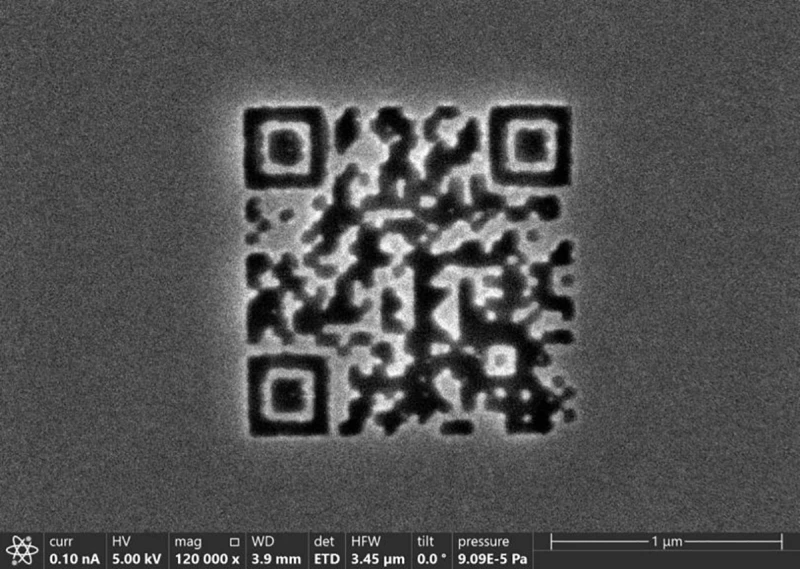
Researchers at the TU Wien miniaturized a specialized barcode to just 1.98 square micrometers—smaller than many bacteria and invisible to optical microscopes—earning a spot in the Guinness World Records.
“Micrometer-scale structures are common nowadays, and we can even create patterns using single atoms,” explained Professor Paul Mayrhofer from TU Wien’s Institute of Materials Science and Technology. “But achieving that alone isn’t enough to produce a stable, readable code.”

TU Wien
Previously, the record for the tiniest QR code was held by a team from the University of Münster, who managed to compress the pattern into just 5.38 square micrometers—far smaller than a human red blood cell. This latest breakthrough wasn’t merely about trimming a few micrometers here and there; it also focused on making the QR code reliably readable over time within such a minuscule space.
Ceramic Film Enables Durable QR Code
The researchers partnered with the German startup Cerabyte and opted for a thin ceramic film as the substrate. We selected this material for its long-term stability under varying conditions, which ensures that the etched QR code remains reliably readable over time.
TU Wien
The team employed focused ion beams to etch the QR code onto the ceramic film, with each pixel measuring a mere 49 nanometers. At this scale, the pixels are roughly ten times smaller than the wavelength of visible light, making the code invisible to the naked eye and only viewable through an electron microscope.
This achievement makes the TU Wien QR code almost three times smaller than the previous record holder. More significantly, it represents progress toward durable, high-density data storage solutions to meet the growing global demand for information archiving. The researchers estimate that a ceramic film the size of an A4 sheet could store over 2 terabytes of data.

TU Wien
Advancing Data Storage
Naturally, there’s still significant work ahead. The researchers plan to expand their efforts by investigating other types of data structures beyond QR codes, as well as experimenting with different materials to achieve reliable, energy-efficient, long-term storage. They also hope to explore ways to make this technology accessible outside laboratory settings.
This ceramic-based approach could compete with other emerging data storage technologies, such as DNA suspended in amber, specialized magnetic molecules that enable ultra-dense storage, novel forms of magnetism for next-generation hard drives, and Microsoft’s method of laser-etching data into glass.
Read the original article on: New Atlas
Read more: The First Laptop in the World Without a Screen, Powered by Augmented Reality


