

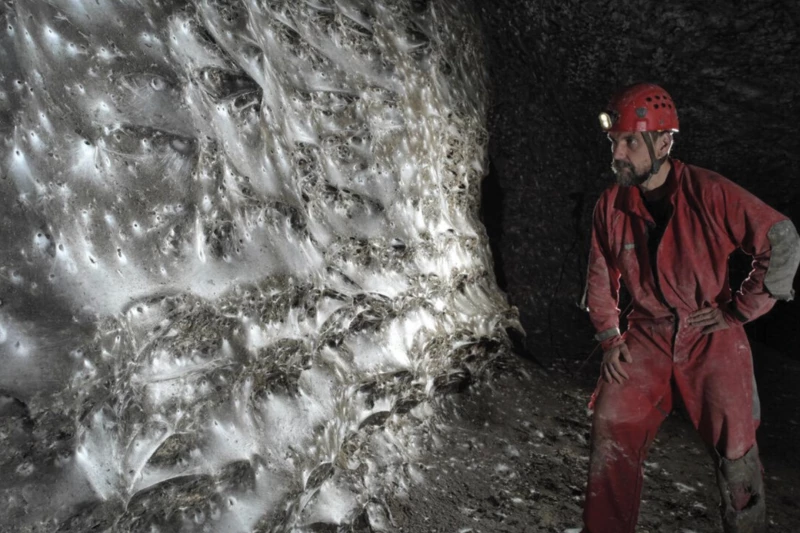
Deep underground in a dark sulfur cave on the Albania–Greece border, scientists found a 100 m² communal web housing around 110,000 spiders.
Researchers Stumble Upon a Giant Web Shared by 110,000 Spiders
In 2022, European researchers, including the Czech Speleological Society, discovered a 106 m² web housing 69,000 Tegenaria domestica and 42,000 Prinerigone vagans spiders living together.
This marks the first documented case of either species living cooperatively — and the first known example of a colonial spider web forming inside a chemoautotrophic cave.
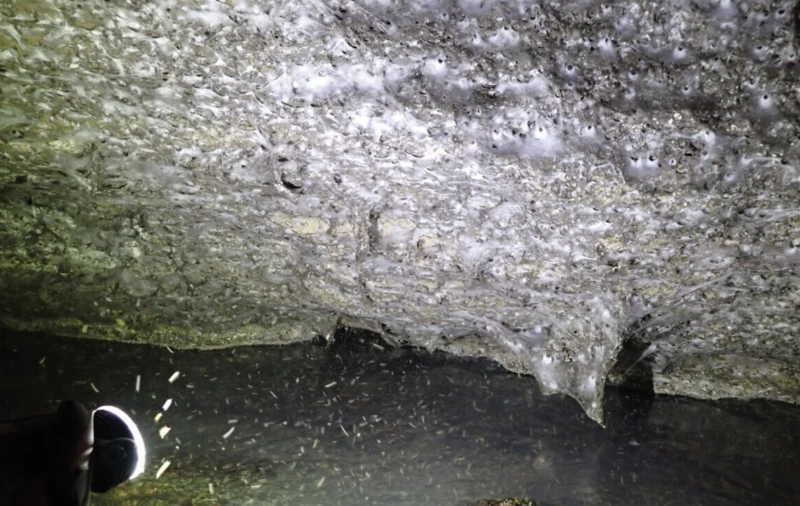
Urák I, et al./Subterranean Biology/(CC By 4.0)
Sulfur Cave hosts a chemoautotrophic ecosystem fueled by chemosynthesis, not sunlight. In this environment, sulfur-oxidizing bacteria form thick white layers on damp rocks and sediment. Invertebrates eat bacteria, and predators feed on them, creating a self-sustaining ecosystem powered by hydrogen sulfide–converting bacteria.
The cave’s unusual life-support system is powered by a warm, toxic stream flowing through it. The water stays around 26 °C (79 °F) and is rich in hydrogen sulfide, giving it a strong rotten-egg smell.
A normally solitary species forms a massive, peaceful super-colony inside Sulfur Cave
The cave’s smell and spider population make it unlikely to become a tourist spot. But for entomologists, the site is extraordinary. Typically, T. domestica—the common house spider—lives alone in a single funnel web. In the cave, thousands of funnels merge into a vast, multilayered web housing countless spiders together. Even more surprising, the researchers detected no signs of the species’ typical cannibalistic behavior.
The team also discovered P. vagans, a smaller sheet-web spider, living within the same massive structure. Outside this environment, T. domestica would normally prey on the smaller species, yet here the two coexist without conflict.
More than 110,000 spiders can coexist peacefully on one web thanks to abundant resources. The cave stream teems with midges, and spiders feed on sulfur-oxidizing bacteria, making the ecosystem fully chemosynthesis-based.
DNA Evidence of an Isolated Spider Population
Genetic tests reveal Sulfur Cave spiders have unique DNA, indicating long-term isolation. Their internal microbial communities were also far simpler. Cave T. domestica lay fewer eggs, likely due to low oxygen and absence of predators.
Researchers say the findings reveal rare colonial behavior in a common spider, driven by abundant resources in a chemoautotrophic cave, highlighting surface species’ adaptation to sulfur-rich underground ecosystems.
Similar recent studies have shown that even cheese-dwelling microbes evolve new strategies to survive in darkness, highlighting how quickly life adjusts to tough conditions.
Sulfur Cave may seem hellish to humans, but it shows life’s adaptability, as these spiders have altered their behavior and biology to thrive without sunlight.
Read the original article on: New Atlas
Read more: A New Study says More Muscle is Linked to Slower Brain Aging


