

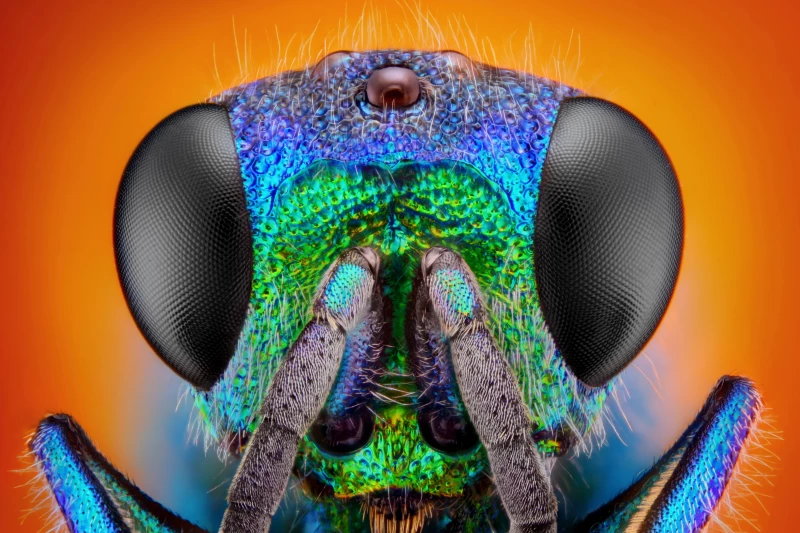
A well-known wasp species, favored by scientists, has revealed another secret — it can pause its development based on environmental cues, which slows aging in adulthood. This discovery suggests that aging isn’t a fixed process and could lead to new directions in aging research and epigenetic treatments.
In a groundbreaking study, University of Leicester researchers discovered that early-life environmental factors—not just time—can shape an insect’s epigenetic clock. They discovered that the jewel wasp (Nasonia vitripennis) can enter a pause during its larval stage, called diapause. Wasps that took this developmental “time out” aged at a molecular level 29% more slowly and lived significantly longer than those that didn’t.
Mapping the Wasp’s Epigenetic Clock Through DNA Methylation Analysis
To gauge how quickly the wasps were aging biologically, the researchers analyzed DNA methylation — chemical tags (methyl groups) that attach to specific DNA sites and change in consistent ways with age. Using whole-genome bisulfite sequencing, they mapped these tags across the entire genome at the single-letter level. From over 700,000 methylated regions (CpG sites), they identified those that changed most with age, eventually narrowing it down to 27 key sites that formed the wasp’s epigenetic clock.
To test this, the team used an environmental trigger — exposing mother wasps to cold and darkness — which induced diapause in their offspring. This dormant state lasted three months, after which the young resumed development and reached adulthood.
Something remarkable occurred: the wasps that underwent diapause lived 36% longer — averaging 30 days compared to 22 — and aged about a third more slowly at the molecular level than those that didn’t pause development.
“It’s as if the wasps who took an early-life break came back with time in reserve,” said senior author Eamonn Mallon, professor of evolutionary biology at the University of Leicester. “It shows that aging isn’t set in stone — environmental factors can shape it even before adulthood.”
Diapause Alters the Pace of Aging, Slowing the Epigenetic Clock
Interestingly, the wasps appeared epigenetically older just after diapause (day six), likely due to methylation shifts during reactivation. But by day 30, they were biologically 2.7 days younger than their non-diapause peers — a meaningful delay in aging when translated to human terms.
An epigenetic clock is like a biological timer that gauges how old your body—or a specific part of it—appears on a molecular level. It does this by tracking changes in DNA methylation. Think of DNA as your body’s blueprint, and methylation as the wear it accumulates over time. Epigenetic clocks monitor these changes to estimate an organism’s biological age, which may differ from its actual chronological age.
This concept has become a hot topic in gerontology, as scientists explore ways to extend healthy aging.
Youthful Hibernation Slows Aging in Wasps, Offering Clues for Human Longevity
In wasps that experienced a kind of youthful hibernation, their biological clocks ticked more slowly throughout life. This offers the first clear evidence that biological aging can be influenced in an invertebrate. Although this type of dormancy isn’t applicable to humans, studying the underlying molecular changes that help preserve wasp DNA may provide valuable insights into the science of aging.
Interestingly, this wasp species also follows a gruesome reproductive strategy: females paralyze fly pupae by injecting venom, then lay their eggs inside. As the larvae hatch, they feed on the still-living host, carefully avoiding vital organs to keep it alive until they’re ready to emerge.
Despite their macabre life cycle, these wasps are a promising model for aging research. Unlike many other invertebrates, they have an active DNA methylation system similar to humans. Their short lifespan and this molecular similarity make them ideal for studying the aging process. They’ve also been studied in neurobiology, especially after their brain was mapped in detail in 2019.
What Wasps Can Teach Us About Slowing Time at the Molecular Level
“Aging is one of science’s biggest puzzles,” said Mallon. “This study doesn’t just tell us more about wasps—it raises exciting possibilities about future molecular-level strategies to slow aging.”
This research is the first to demonstrate the lasting impact of a dormant state that some animals can enter. Scientists found that specific biological pathways drive this molecular slowing of aging — including ones linked to insulin and nutrient sensing that also exist in humans. These shared pathways are now a focus of aging research.
Surprisingly, this tiny parasitic wasp shares more biological similarities with us than one might expect. Its epigenetic clock and the way it ticks are drawing significant attention from scientists.
“With its genetic toolkit, measurable signs of aging, and a clear connection between development and lifespan, Nasonia vitripennis is emerging as a key model in aging studies,” Mallon said. “In essence, this small wasp might offer major insights into how we could slow the aging process.”
Read the original article on: New Atlas
Read more:One Diet Soda a Day May Boost Type 2 Diabetes Risk by 38%


