

Luke/Mike Bell
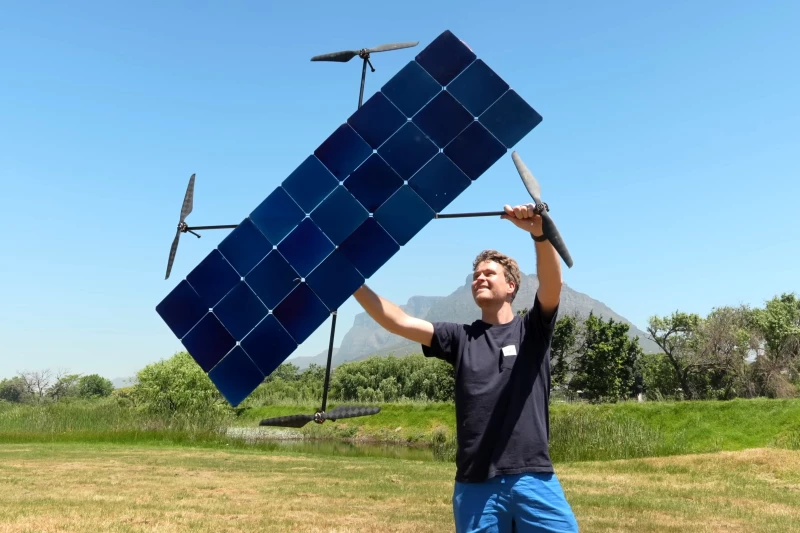
The father-and-son duo behind last year’s record-breaking quadcopter has now developed a drone that resembles a flying solar panel, aiming for a design powered entirely by sunlight.
This story has two parts. First, an update on the Peregrine project, which previously set the Guinness World Record for the “Fastest ground speed by a battery-powered RC quadcopter” at 480 km/h (just under 300 mph).
The Bells Gear Up to Reclaim the Speed Crown
Earlier this year, that title was taken by student Samuele Gobbi and his Fatboy 2 drone, which reached 557.64 km/h (346.5 mph). In response, Luke and Mike Bell began work on the Peregrine 3 to reclaim the record.
A build video is available below, and while official record attempt footage is still pending, the Peregrine 3 team traveled to Dubai in June and surpassed the Fatboy 2, achieving a top speed of 585 km/h (363 mph), with an official average of 570 km/h. Congratulations to the Bells on their new Guinness World Record.
Today, we’re focusing on the Bell team’s effort to create a multi-rotor drone that can remain airborne solely under sunlight. While similar research projects exist, they relied on solar cells to charge onboard batteries. The Bells aimed to eliminate batteries entirely.
The drone itself is the simpler part of the equation: it features an X-frame made of carbon fiber tubing, lightweight Antigravity motors, 18-inch carbon fiber props from T-Motor, a flight controller, 3D-printed mounts, and small cameras feeding a POV VR headset.
Wiring Solar Panels for Flight
Twenty-seven delicate solar panels were wired in series, producing roughly 150 watts during ground tests. Some panels broke during gentle handling, and the family cat proved even more destructive. The panels were mounted on a 3-mm carbon fiber support structure, which was then bolted to the drone’s X-frame.
With the build complete, the Bells carefully loaded the drone into a vehicle and took it to an open field for real-world testing. A detailed video shows the first flight powered entirely by solar energy—no batteries, no capacitors—demonstrating the concept in action.
Of course, a drone like this isn’t likely to have immediate practical applications. But as a “what if” engineering experiment, it’s incredibly intriguing. Judging by their track record, we can likely expect an upgraded version to take flight sooner rather than later. In the meantime, hats off to the team.
Read the original article on: Newatlas
Read more:Atlas Humanoid Robots will be Deployed in Hyundai Factories


