

Nanyang Technological University
Instead of painstakingly building miniature robots from scratch, researchers are now transforming real insects into remote-controlled cyborgs—and a new automated production line dramatically speeds up the process.
How Cyborg Insects Work
In simple terms, a cyborg insect is usually a large bug—often a Madagascar hissing cockroach—outfitted with a tiny electronic backpack. Electrodes inside the pack can be activated remotely to stimulate the insect’s antennae or eyes, prompting it to walk, stop, or turn on command.
Far from being a creepy curiosity, these insect hybrids have serious potential. One major proposed use is disaster search and rescue: a camera-equipped cyborg cockroach could crawl through tiny gaps in rubble, relaying live footage and the coordinates of any trapped survivors.
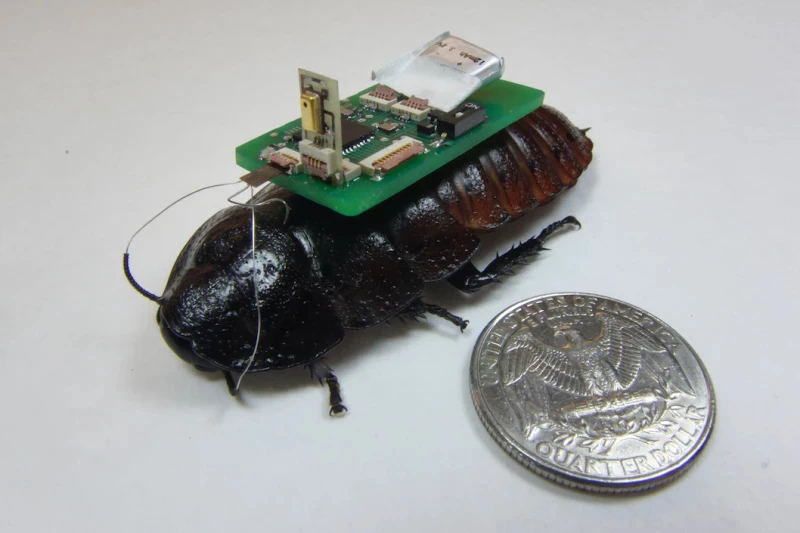
Eric Whitmire
Such missions would require swarms, not just a handful, of these robotic insects. The vision is to deploy dozens or even hundreds at once, with their backpacks wirelessly coordinating search routes to avoid overlap and cover more ground efficiently.
The Need for Speed and Consistency
To make this approach viable, scientists need a faster, more consistent way to prepare the cockroaches than manually outfitting each one. That’s where the new assembly line comes in.

Nanyang Technological University
Developed by Professor Hirotaka Sato and his team at Nanyang Technological University in Singapore, the fully automated setup includes a holding platform for the insect, an Intel RealSense depth-sensing camera, and a UR3e robotic arm with a Hand-E gripper.
Step-by-Step Automation
The process begins with anesthetizing the cockroach and securing it on the platform. The system then slides into place, and computer vision measures the insect’s size and position. The researchers lift a small section of its outer shell to reveal the membrane between the pronotum and mesothorax.
Installing the Backpack
The team lowers a preassembled 2.3-gram backpack onto the insect, inserts two electrodes into the membrane, presses the pack into position until it clicks securely, and releases the insect once the platform moves back.
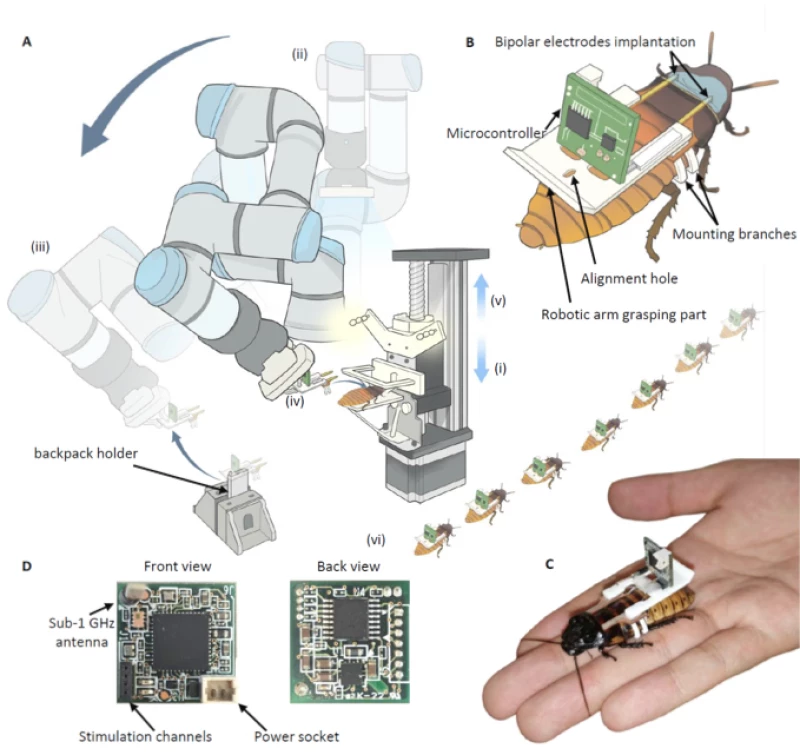
Nanyang Technological University
This entire operation takes just 68 seconds per cockroach—compared to 15 minutes to an hour when done by hand. Performance tests showed that both assembly-line and hand-prepared cyborg cockroaches navigated tasks like S-shaped paths and cluttered spaces equally well.
Energy Efficiency and Reusability
The design also benefits the insects and extends battery life, using only 40% of the stimulation time and 75% of the voltage required by similar systems. Researchers can even remove the backpacks between missions.
Our system makes the idea of deploying large numbers of cyborg insects in real-world scenarios far more realistic,” said Sato. “Automation lets us produce them quickly and reliably—an essential capability for urgent operations like post-disaster rescue.
Read the original articel on: New Atlas
Read more: Robotic Hand Demonstrates Lifelike Skill in Intricate Laboratory Tasks


