

Image Credits: Depositphotos
Gut support cells send precise messages—much like brain neurons—using fine extensions to guide the stem cells that maintain and repair the intestine. This finding could reshape how we understand tissue healing and gut disorders.
The intestinal lining, known as the epithelium, undergoes constant renewal, replacing all its cells every four to five days. This process relies on stem cells located in tube-shaped “crypts” within the gut lining, which divide and develop into various cell types to replace old cells.
Gut Cells Found to Communicate with Neuron-Like Precision
Researchers from Duke-NUS Medical School and Nanyang Technological University (NTU Singapore) have discovered a surprisingly precise communication system in the gut, resembling how neurons interact in the brain.
“Examining the fundamentals closely can sometimes lead to breakthrough insights,” said Dr. Gediminas Greicius, principal research scientist at Duke-NUS’ Cancer and Stem Cell Biology Program and lead author of the study. “This targeted signaling system was right in front of us, and recognizing it transforms how we view gut stem cell biology.”
It all centers on Wnts signaling molecules that regulate the activity of intestinal stem cells located in the crypts. More specifically, these stem cells reside in a specialized “niche,” a tightly controlled microenvironment that governs their function. When Wnt signaling is activated, it triggers stem cell growth and division, helping to maintain the balance between self-renewal (preserving the stem cell pool) and differentiation (producing specialized cells for the intestinal lining).
Originally, scientists believed Wnts spread passively through the tissue to reach stem cells. However, this new study challenges that assumption.
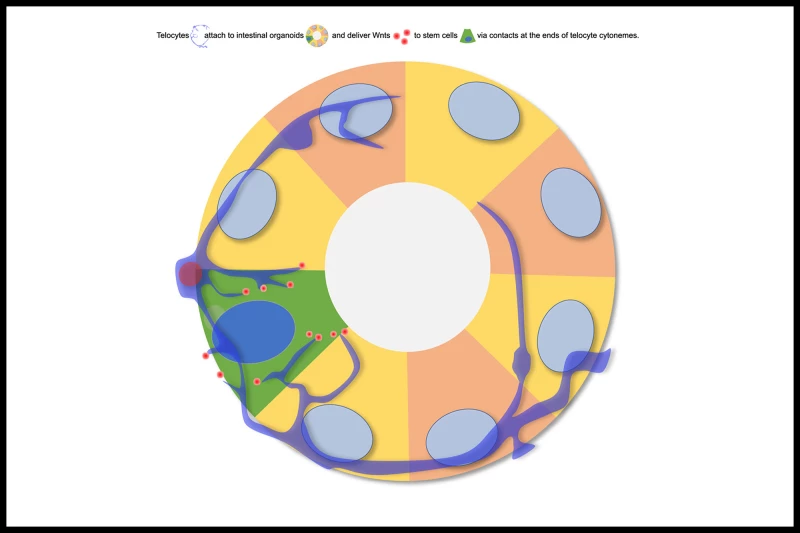
Duke-NUS Medical School/Greicius et al. 2025
Telocytes Relay Gut Signals with Precision, Mirroring Neuronal Communication
“These signals don’t just drift through tissue,” said Professor David Virshup, co-corresponding author and CSCB Director. Instead, specialized cells called telocytes deliver signals with precision, much like neurons in the brain.
Telocytes are intriguing for their long, thread-like cytonemes that connect directly to stem cells. Using advanced imaging, researchers saw telocytes deliver Wnt molecules to individual stem cells via cytonemes in mouse intestines. Telocyte-stem cell contacts resemble synapses, revealing neuron-like precision in this system.
“This direct delivery shows a new level of precision in signaling,” said Assistant Professor Alexander Ludwig of NTU Singapore. “It’s a striking demonstration of how high-resolution imaging and innovative protein tagging can uncover new biological processes and shift existing paradigms.”
Disrupted Gut Signaling May Play a Role in Cancer and Inflammatory Bowel Diseases
The study’s findings could have broad implications. Disrupted Wnt signaling already drives certain colon cancers and may fuel chronic inflammatory bowel diseases such as Crohn’s disease and ulcerative colitis.
“This breakthrough could change how we approach tissue repair,” said Professor Patrick Tan, Senior Vice-Dean for Research at Duke-NUS. Replicating this precise signaling could enhance stem cell therapies and improve treatment for gut disorders. It’s a powerful reminder of how fundamental science can pave the way for real-world medical advances.
Read the original article on: New Atlas
Read more: AI-Enhanced Microscope Forecasts and Monitors Protein Clumping Tied to Brain Disorders


