


Astronomers could potentially detect Dyson swarms by searching for unusually cool, smooth infrared emissions surrounding long-lived stars.
Since physicist Freeman Dyson first proposed the concept in 1960, the “Dyson sphere” has become one of the most prominent hypothetical technosignatures in the search for advanced extraterrestrial intelligence.
A highly advanced civilization might surround its star with a swarm of collectors to capture most or all of its energy output. While this is theoretically feasible, astronomers continue to ask what such a system would actually look like from Earth.
A recent arXiv preprint by Amirnezam Amiri at the University of Arkansas explores this question and pinpoints which types of stars could be the most promising targets for searching for Dyson swarms.
Smaller Stars are Better Candidates for Observation
One particularly promising type is the red dwarf star. These are the most common stars in the Milky Way, burning fuel slowly and lasting extremely long—some may survive for trillions of years, far beyond the universe’s current age.
Since red dwarfs are also much smaller than the Sun, a Dyson swarm could orbit relatively close to them, roughly 0.05 to 0.3 astronomical units from the star’s surface, which would significantly reduce the amount of material required for construction.
White dwarfs may be even more appealing from an engineering perspective. They are the compact, cooled remnants of Sun-like stars, squeezed down to extremely small sizes with radii roughly 1% of their original stars. A Dyson swarm around a white dwarf could orbit just a few million kilometers above its surface, which would make building such a vast energy-harvesting structure significantly easier than around larger stars. In addition, white dwarfs can shine steadily for billions of years, offering potentially stable long-term energy sources.
Starlight Would Be Converted into Thermal Energy
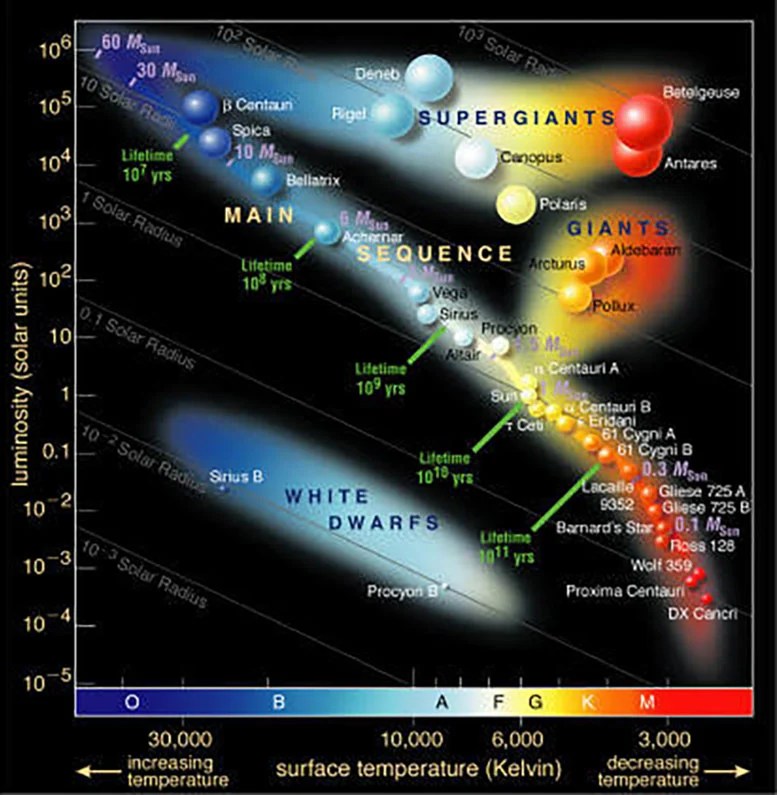
But what would a star enclosed by such a megastructure actually appear like? Astronomers usually classify stars using the Hertzsprung–Russell (H-R) diagram, which plots stellar temperature against luminosity. However, if a Dyson sphere blocked all visible starlight, it would radically alter the star’s position on this diagram.
Because energy cannot be created or destroyed, the structure would still have to re-emit all the absorbed energy, but in a different form—primarily as heat, or infrared radiation. In effect, a Dyson sphere would act as a shell that captures a star’s light, uses that energy for some purpose, and then reradiates it as thermal emission.
As a result, the object would shift far to the right on the diagram, corresponding to much cooler temperatures. Its total luminosity would remain unchanged, since H-R diagrams use bolometric luminosity (total energy output across all wavelengths). Only the spectrum would shift toward the infrared, so it would still appear at the same vertical position as its host star, whether it is a red dwarf or a white dwarf.

The main point is how dramatically far to the right the star would shift. A normal red dwarf in the lower-right of the H-R diagram has a surface temperature around 3000 K. In contrast, a Dyson sphere would radiate at temperatures as low as ~50 K, about two orders of magnitude colder. Since no natural stars lie there, any object found would be a strong Dyson swarm candidate.
Unusual Signals Could be Easily Distinguishable
Another clue that an object could be a Dyson swarm is the absence of dust. Try using active counterparts instead: normal stars typically show silicate emission features linked to dusty disks. In contrast, a Dyson swarm of radiator panels would produce no surrounding dust, making it appear unusually “clean” in spectroscopy.
In swarm designs, gaps between collectors are needed to make material demands feasible, since solid Dyson spheres are considered impractical even at small scales. If gaps existed, the star’s brightness would vary irregularly as the structure rotates, creating unusual light curves.
Some Telescopes Have Already Identified Possible Candidates
Because the James Webb Space Telescope is optimized for infrared observations, it is particularly well suited to detecting these kinds of structures. However, earlier instruments like Wide-field Infrared Survey Explorer are also still being used in ongoing searches.
In May 2024, Project Hephaistos reported seven potential Dyson sphere candidates around red dwarfs, found among about five million stars. One was later ruled out when the anomaly was traced to a perfectly aligned background supermassive black hole.
That still leaves five promising candidates that merit further follow-up observations. The new research adds another useful framework for astronomers refining how to identify these rare technosignatures.

Read the original article on: SciTechDaily
Read more: NASA’s Psyche spacecraft used Mars’s gravity for a slingshot maneuver to adjust its path


