

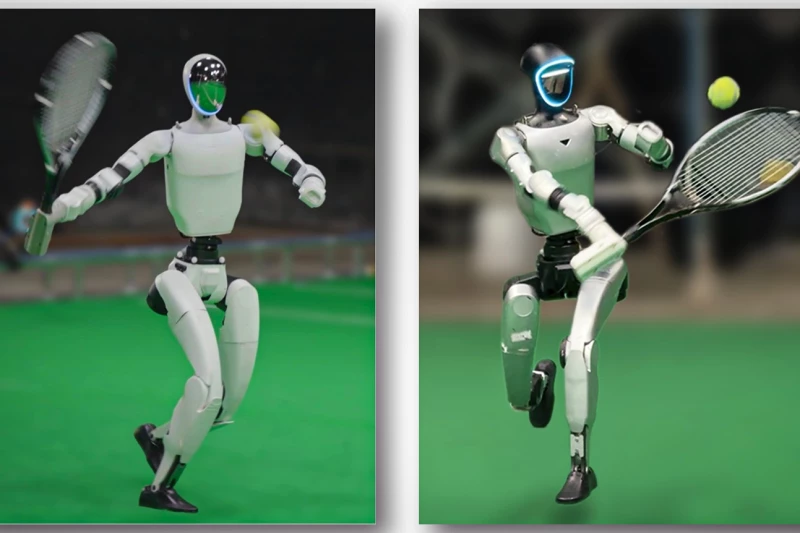
Zhang et al, Tsinghua university
This isn’t teleoperation. Chinese researchers have tested a faster, more efficient method for training robots in tennis, showing a major leap in AI and machine learning.
What does it take to be a capable athlete? Extremely precise perception, coupled with strong coordination, sharp anticipation, quick reflexes, and mastery of sport-specific techniques.
That last part has proven especially difficult for robotics researchers. In tennis, wearable motion-capture systems can’t track players’ full movement during rallies or capture subtle wrist and fine details that define shot quality. The game is simply too fast and fluid for teleoperation to work effectively.
Extracting this detail from multi-camera TV footage with AI tools like Nvidia’s Vid2Player3D is equally challenging. Zhang and colleagues describe it as a “complex pipeline” requiring substantial expertise and engineering effort.
The LATENT system revisits motion capture, focusing on core techniques and handling imperfect data. The researchers used five hours of motion-capture recordings of athletes performing core tennis skills—forehands, backhands, lateral shuffles, and crossover steps—on a small court area.
Robot Tennis From Human Motion
The researchers processed this motion-capture data to build a library of human-like “motion spaces,” then transferred these foundational skills to a robot—specifically Unitree’s G1 humanoid, known for everything from dancing to kickboxing and priced at roughly US$13,500.
In essence, the LATENT system gave the robot a framework: “This is how you should move. Now, using similar motions, track an incoming tennis ball and hit it back over the net. A successful shot lands within the court boundaries on the other side.”
With this foundation, the robot could independently refine timing, angles, movement choices, and when to exceed its training. Most of this learning happened rapidly in simulation.
In real-world tests, the G1 hit forehands successfully 90% of the time and backhands just under 80%, moving with human-like agility and fluidity.
Obviously, it’s not Wimbledon-ready—or fit for any competitive match just yet. But as an early-stage effort, it’s a striking leap forward.
It seems likely that soon a US$10,000 Chinese robot could serve as a surprisingly competent tennis practice partner, gradually moving us toward a future where top professional players might have about as much chance against these machines as a chess grandmaster does against an AI.
Though professional tennis isn’t the routine work robots were expected to take over, they gain human-like benefits: mastering body control, navigating fast-changing environments, and developing transferable skills—just hopefully less violently than “smashing opponents Agassi-style!”

Read the original article on: New Atlas
Read more: BMW Factory Deploys humanoid robots powered by physical AI


