

Tesla
We’ve tamed fire, split the atom, and launched ourselves beyond Earth. We’ve created machines that surpass our intelligence, gadgets that can make our meals, and instruments precise enough to open our bodies for life-saving surgery. All of that is remarkable. Traveling through space is awe-inspiring, no doubt … but it doesn’t mirror who we are. It doesn’t carry the essence of being human.
So, what comes next? Naturally, it’s teaching humanoid robots to move the way we do—through dance. And dancing isn’t unique to humans, either. Take Birds of Paradise: their mating displays are so elaborate that people gather in groups just to witness them. Males fan out their feathers and perform rhythmic steps to win over potential mates—remarkably similar to our own behavior.
The Manakin might even outshine Michael Jackson when it comes to moonwalking, while Australia’s Peacock Spiders put on performances as dazzling as their colorful costumes.
And it’s not just birds—bugs dance too. For insects, though, the moves are more geometry than groove. Honeybees, for instance, use a “waggle dance” to point their hive-mates toward food in relation to the sun—like a tiny, fuzzy Pythagoras shaking its hips.
“The best case for building robots in a human shape is that our world is already designed around us. Humanoid robots can slip right into our spaces, adapt to what’s already here, and be repurposed with little friction,” explains Humanoid, the company behind the HMND 1.
It’s a fair point. The human form also makes it easier for us to project feelings onto these machines—for better or worse. I’ve even been a little touched by some clips, like one from 1X showing its Neo Gamma robot doing chores, looking oddly forlorn as people around it barely notice.
But when a humanoid robot starts dancing? That’s a whole different energy—fun, joyful, and yes, just a bit uncanny. Few things capture the essence of being human as much as dance does.
Before Robots, There Were Puppets on Pulleys
Of course, dancing robots aren’t new. For decades, animatronics have been programmed to entertain us. Disney’s It’s a Small World ride, first shown at the 1964 New York World’s Fair before moving to Disneyland in 1966, is basically an endless parade of little puppet-like figures shimmying on hydraulics and pulleys. And Chuck E. Cheese’s Pizza Time Players have been both delighting and terrifying kids since 1977.
Fast-forward sixty years, and the tech landscape looks completely different. Now we’re talking about onboard CPUs and GPUs, reinforcement learning, physics simulations, proprioception, computer vision with real-time recognition, SLAM navigation, gyros, accelerometers, tactile sensors, microcontrollers, efficient servos, and batteries that last for hours.
One of the first big pop-culture moments I remember was back in 2005, when Beck’s Hell Yes video showcased a swarm of Sony QRIO robots tearing up the dance floor. At the time, it was jaw-dropping. The QRIO—short for “Quest for cuRIOsity”—stood just two feet tall, weighed 16 pounds, had 38 degrees of freedom, and could run, jump, walk, and most importantly, dance. But they were never sold to the public, and by 2006, the project was abruptly discontinued.
In 2008, Aldebaran Robotics made a splash with the release of the NAO robot. Designed primarily for education, it quickly found roles in therapy, autism support, and STEM learning. Standing 22.8 inches (58 cm) tall, weighing 11.9 pounds (5.4 kg), and equipped with 25 degrees of freedom, the NAO was marketed mainly to schools and research labs, with a price tag ranging from $7,000 to $15,000.
While not fully open source, the robot could be programmed within set parameters. Almost immediately, users began hacking it into a dancing companion using Choregraphe, a drag-and-drop motion sequencing tool. The most iconic example? A NAO-robot version of Judson Laipply’s Evolution of Dance.
By 2017, Toyota unveiled its T-HR3 robot—remarkably smooth in motion, even capable of performing graceful Tai Chi routines. The catch was that it wasn’t autonomous; instead, it mirrored the movements of a human wearing a control suit and VR headset. Still, it earned a spot on this list because it was among the first to achieve such human-like fluidity, offering a glimpse of what future robots might be capable of.
In late 2020, Boston Dynamics stole the spotlight. While much of the world was stuck at home in lockdown, Spot, Atlas, and Handle broke out into the mashed potato, the twist, and a full choreographed routine set to The Contours’ 1962 classic Do You Love Me? The video racked up around 42 million views, leaving audiences stunned.
The first-generation Atlas—a 4-foot 11-inch (1.5 m), 176-pound (80 kg) humanoid robot powered mostly by hydraulics—moved so convincingly that even years later, some people still insist the footage was CGI. It wasn’t. In fact, pulling off that routine actually exposed weaknesses that pushed Boston Dynamics to upgrade Atlas. And let’s not forget, Atlas was also the first humanoid robot to successfully land a standing backflip back in 2017.
Since then, the pace has only accelerated.
China’s Unitree made waves with the G1—a 4-foot 4-inch (1.3 m), 77-pound (35 kg) humanoid boasting up to 43 degrees of freedom, 3D LiDAR, functional hands, and jaw-dropping agility. It was the first humanoid to land a front flip, the first to pull off a backflip without hydraulics, and it can spring up from its back like a trained martial artist. Oh, and of course—it dances. Honestly, better than I can.
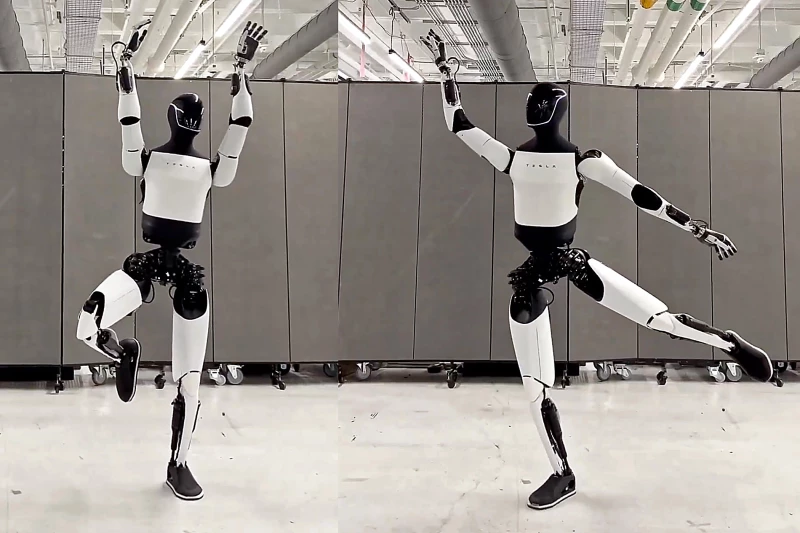
The real spark for this whole piece came from Tesla’s Optimus.
Milan Kovac, Tesla’s former VP of Optimus Engineering, shared a clip of the robot showing off reinforcement-learning dance moves—executed “zero-shot” from simulation to the real world. In other words, it practiced the routine virtually, then pulled it off flawlessly on the first attempt in real life. That’s like picturing yourself performing Swan Lake while lounging on the couch, then standing up and actually nailing it.
When Robots Start to Dance Gracefully
It was a short clip, but watching Optimus pull off a simple ballet move floored me. I’d never seen a humanoid robot attempt genuine ballet before, and it felt like a milestone—a real leap in robotic ability. Huawei did a partial ballet collaboration back in 2021, but this was operating on an entirely different level.
Curious, I asked my wife—who’s staunchly anti-AI and anti-robot—what she thought. Her response was blunt: “Why are we making robots like humans? I don’t like it.” Judging by the flood of similar comments on YouTube, she’s not alone.
And yet … here we are.
From QRIO to Optimus, humanoid robots have danced their way into the cultural spotlight. But they’re no longer just novelties—today’s humanoids are advanced platforms backed by hundreds of millions in R&D. Building a single unit can run well over $100,000. They move with a balance, fluidity, and precision that sometimes makes us look awkward by comparison. Teaching these machines to waltz, break into the running man, or even execute a plié isn’t just about spectacle—it’s about pushing the boundaries of movement, AI, and human-robot interaction.
So maybe choreographing robots isn’t the next grand leap in technology … but it might just be the most human step we’ve taken.
Read the original article on: New Atlas
Read more:See Spot Backflip: Robodog Achieves an Unexpected Feat


