

Image Credits: Depositphotos
Sleep is often viewed as a passive break from wakefulness, but new research reveals it’s an active and essential biological function. A recent study has demonstrated that during sleep—particularly at night—the brain plays a key role in releasing growth hormone, which helps repair muscles, strengthen bones, and regulate metabolism. Scientists have now identified the brain circuits responsible for the nighttime surge of this hormone, revealing why insufficient sleep can negatively affect physical health.
Breakthrough Study Reveals How Deep Sleep Triggers Growth Hormone Release
In a breakthrough animal study, researchers at the University of California, Berkeley, have, for the first time, uncovered the mechanism behind the rise of growth hormone during deep sleep. Although researchers have known that GH levels rise at night, they hadn’t identified the exact cause until now. The team discovered a unique feedback system that regulates hormone levels to support essential functions like muscle growth.
Scientists have long known that sleep closely influences growth hormone release, but until now, they’ve primarily observed this by directly measuring hormone levels in blood samples taken during sleep,” explained Xinlu Ding, the study’s lead author and a postdoctoral researcher in UC Berkeley’s Department of Neuroscience. “What we’re doing differently is directly monitoring brain activity in mice to understand what’s happening. Our findings lay the groundwork for future research aimed at developing new treatments.”
New Insights Reveal How Skipping Sleep Can Accelerate Aging and Undermine Muscle Health
Using a combination of genetic techniques, calcium imaging, and optogenetics, the researchers mapped how the “gas pedal” (GHRH) and “brake” (somatostatin) hormones behave differently during REM and non-REM sleep. They found that during REM sleep, both somatostatin and GHRH activity increases, working together to elevate growth hormone levels. In contrast, during non-REM sleep, somatostatin activity drops while GHRH rises slightly—still resulting in a GH boost, but through a different balance of signals.
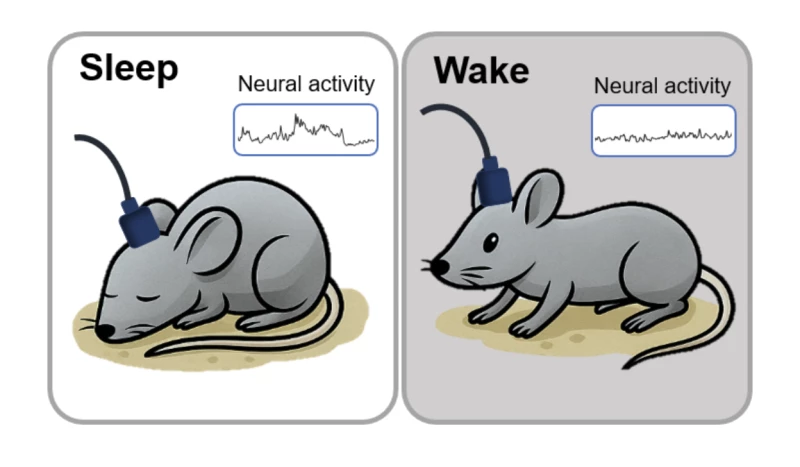
Yang Dan lab/UC Berkeley
If this all seems a bit complex, you’re not alone. The researchers discovered that somatostatin (SST), typically known for suppressing growth hormone, also helps regulate its timing. During REM sleep, brief bursts of both SST and GHRH trigger sharp spikes in growth hormone release. In non-REM sleep, SST activity drops, allowing for a steadier flow of GH. This interplay actively regulates GH release, aligning it precisely with different sleep phases.
Growth Hormone and the Brain’s Wakefulness Center Work in a Delicate Sleep-Wake Balance
The study also uncovered a feedback loop between growth hormone and a brainstem region called the locus coeruleus, which helps regulate alertness. As GH accumulates during sleep, it subtly activates this brain hub to begin preparing the body to wake up. However, when the locus coeruleus becomes overly stimulated, it shifts gears and actively promotes drowsiness. This creates a delicate yin-yang dynamic, where sleep boosts GH production, and GH in turn helps regulate the cycle of sleep and wakefulness.
In simple terms, the key takeaway is that the nighttime pulses of growth hormone (GH) released into the bloodstream play a crucial role in preparing the body’s tissues for repair and regeneration.
“This points to a finely tuned relationship between sleep and growth hormone,” explained co-author Daniel Silverman, a postdoctoral researcher at UC Berkeley. “Not getting enough sleep reduces GH release, while excess GH can actually nudge the brain toward wakefulness. Sleep triggers GH production, and GH, in turn, helps regulate when we wake up. This balance is vital for physical growth, tissue repair, and maintaining a healthy metabolism.”
Sleep Loss Disrupts the Body’s Prime Time for Repair, Growth, and Healthy Aging
Missing sleep doesn’t just make you tired the next day—it causes you to skip a critical window when your body performs repair and recovery. This period, driven by growth hormone (GH), is essential for anyone looking to build muscle, maintain bone density with age, or manage weight and blood sugar. Since GH levels naturally decline as we get older, prioritizing good sleep may be one of the most effective ways to support healthier aging.
“Growth hormone doesn’t just support muscle and bone development or fat reduction—it may also enhance brain function by boosting alertness upon waking,” added Ding.
Although the researchers conducted the study in mice, humans share the same neural circuits, and their hormone release patterns closely mirror those findings. By uncovering how different sleep stages regulate growth hormone (GH), scientists can now target and fine-tune the rhythm vital for physical restoration.
New Insights Reveal How Skipping Sleep Can Accelerate Aging and Undermine Muscle Health
Past studies have already linked poor sleep to accelerated biological aging, and this new research adds further depth to our understanding of the complex processes happening between sleep and wakefulness. The key message: if you’re aiming to build or maintain muscle, missing sleep can negatively affect your body in both the short and long term.
“By identifying the brain circuit responsible for GH release, we may eventually develop new hormone-based treatments to improve sleep quality or restore proper GH balance,” said Daniel Silverman, a postdoctoral fellow at UC Berkeley and study co-author. “There are emerging gene therapies that can target specific cell types, and this circuit may offer a new way to reduce overactivity in the locus coeruleus—something that hasn’t been explored before.”
Read the original article: New Atlas
Read more: Cravings Are Not a Reliable Indicator of Cancer, According to Experts


